
Addressing Police Violence and Its Impact on HIV/AIDS Response in Ukraine
This document explores the detrimental effects of police violence on marginalized populations, particularly in the context of HIV/AIDS in Ukraine. It highlights how punitive laws and human rights abuses lead to increased HIV transmission, particularly among drug users and sex workers. With a population of 45.6 million, Ukraine faces serious challenges as police violence promotes criminalization and hinders harm reduction efforts. The report proposes solutions such as legislative changes, police training, and improved cooperation with NGOs to mitigate these issues and protect human rights.

Addressing Police Violence and Its Impact on HIV/AIDS Response in Ukraine
E N D
Presentation Transcript
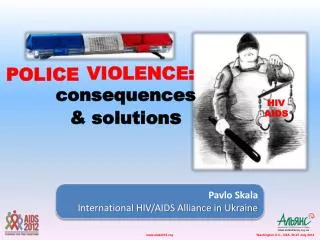
POLICE VIOLENCE: consequences & solutions HIV AIDS PavloSkala International HIV/AIDS Alliance in Ukraine
POLICE VIOLENCE: just wording Police: 88 240 82 violence/violation/harassment etc: 42 105 198
«Punitive laws and human rights abuses are costing lives, wasting money and stifling the global AIDS response»The Global Commission on HIV and the Law, July 2012
Ukraine: just figures 45 600 000 - population (2011) 230 000 - IDUs (estimate, 2011) 70 000 – FSWs 230 000 - PLWHA 202 787 - officially registered HIV-cases (since 1987) 21178 - registered cases of HIV in 2011 94 671 - IDUs among all cases of HIV (since 1987) and 350 000 - number of police staff (770 per 100 000 population)
Per capita of police officers in different countries (per 100000 population) • USA – 233 • Poland - 322 • Germany - 321 EU-27 - 352 • Russia - 773 • Ukraine - 770
Examples of police violence in relation to OST clients Collecting personal information Including HIV status on 6 000 OST patients (January-February 2011)
Example of police violence in relation to OST providers Fabrication of the criminal case against 62 y.o OST physician in Odessa (the Doctor Podolian’s case, 2010-2012)
Examples of police violence in relation to MARPs (FSW) Fabrication of pimping case in relation to FSWs Kiev, November 2011-April 2012
Consequences of police violence for MARPs • Further criminalization of IDUs and FSWs • High level of incarceration of IDUs: prison as incubator for HIV, TB & HCV • Serious obstacles to implementing Harm Reduction/OST programs • Further spread of the epidemics among MARPs leading to spread of the epidemics among general population
Consequences of police violence for Harm Reduction/OST staff • Imprisonment • De-motivation and panic among clients • High turnover/refuse to work in HR/OST programs • Instability and uncertainty of HR/OST programs • Further escalation of problems caused by police • Developing of negative public opinion on HR/OST
Solutions (1) • Legislation changes (decriminalization, high police standards, detective and investigation procedures) • Police/clients education • Support programs to challenge stigma and discrimination • Improving cooperation between police and NGOs
Solutions (2) • Monitoring of observing human rights of vulnerable groups • Investigation of police violence incidents • Police recognize human rights of MARPs • Strategic litigation cases • Media involvement
THANK YOU ! • PavloSkala • Tel.: +380503825178e-mail: skala@aidsalliance.org.ua
