Sink or Float? Understanding Density with R. Bryant's Experiment
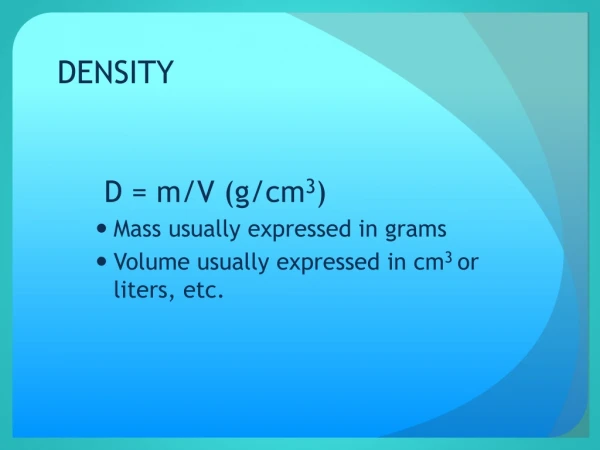
In this experiment based on "Science Starters" by T. Trimpe, students learn to calculate density to determine if an object will sink or float. Using a box with a mass of 456 g and dimensions of 12.5 cm x 5.6 cm x 5.6 cm, we calculate the volume and density. The volume is determined by V = length x width x height, resulting in 392 cm³. The density is found using the formula D = Mass ÷ Volume, yielding a density of 1.16 g/cm³. Since the density is greater than that of water, the box will sink!

Sink or Float? Understanding Density with R. Bryant's Experiment
E N D
Presentation Transcript
Sink or Float? Density #1 R. Bryant 2008 WSMS – Based on “Science Starters” by T. Trimpe at http://sciencespot.net
Find the density of the box below. Mass456 g 12.5 cm 5.6 cm 5.6 cm
The solution … Volume = length x width x height V = 12.5 cm x 5.6 cm x 5.6 cm V = 392 cm3 M = 456 g Density = Mass ÷ Volume D = 456 g ÷ 392 cm3 D = 1.16 g/cm3 **The box would sink!