Download

1 / 7
70 likes | 228 Vues
Ocean surface currents, driven by winds and Earth's rotation, significantly influence global climate by redistributing warm and cold water across the major oceans. Of these, the Gulf Stream, the most powerful current in the North Atlantic, transports vast amounts of water, affecting temperatures and weather patterns in coastal regions. These currents interact with wind patterns, influencing phenomena such as El Niño and La Niña, which cause variations in precipitation and climate. Understanding these dynamics is crucial for comprehending our planet's climate system.

E N D
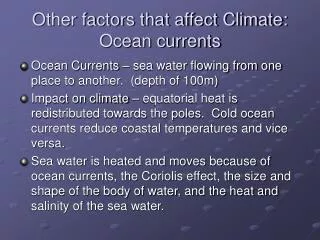
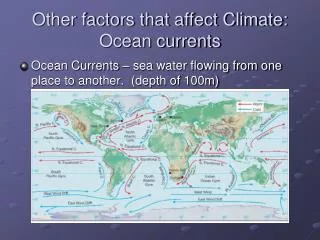
Surface Currents (ocean) • Affect water to a depth of several hundred meters • Driven by winds • Move in circular patterns in 5 major oceans. • Because of Coriolis effect– affects wind current movements because of Earth’s rotation. • Northern hemisphere – curve to right • Southern hemisphere – curve to left
Gulf Stream • Largest, most powerful current in the North Atlantic Ocean. • Caused by strong winds from the west. • More than 30 km wide and 300 meters deep. • Carries more than 100 times the amount of water in the MS river. • Carries water from Gulf of Mexico to Caribbean Sea, then north.
Effects on Climate • Gulf Stream and North Atlantic Drift cause coastal areas to have temperate climates (little change in temperatures). • Currents affect climate by moving cold and warm water around the globe. • Causes air above the current to warm or cool. • Winds pick up moisture as they move across warm currents.
Wind Patterns • Trade winds flow through tropics – steer tropical storms in the ocean. • Prevailing westerlies move air masses and fronts. • Jet streams – fast flowing, narrow atmospheric currents. • Can significantly affect climate • Dust Bowl in 1930s – weak stream caused drought. • El Niño – greater precipitation in SE U.S. and Upper Midwest • La Niña – greater precipitation in Pacific NW.
Air Masses • Tropical – warm air • Polar – cold air • Maritime – forms over oceans – wet air • Continental – forms over land – dry air