
1 / 5

UID Lifecycle Management: Enhancing Data Integrity and Inventory Control

This document outlines key requirements and issues related to UID (Unique Identification) lifecycle management from a logistics perspective. It discusses the review of UID pedigree data elements, identifies existing legacy items, and addresses additional data elements necessary for warranty information and cataloging capabilities. It also highlights the distinctions between mandatory and conditional data, the proper use of the UID registry, and the challenges of configuration management. Action items include refining business rules and improving data integrity for effective asset management.
kamali
Télécharger la présentation

UID Lifecycle Management: Enhancing Data Integrity and Inventory Control

An Image/Link below is provided (as is) to download presentation Download Policy: Content on the Website is provided to you AS IS for your information and personal use and may not be sold / licensed / shared on other websites without getting consent from its author. Content is provided to you AS IS for your information and personal use only. Download presentation by click this link. While downloading, if for some reason you are not able to download a presentation, the publisher may have deleted the file from their server. During download, if you can't get a presentation, the file might be deleted by the publisher.

E N D

Presentation Transcript


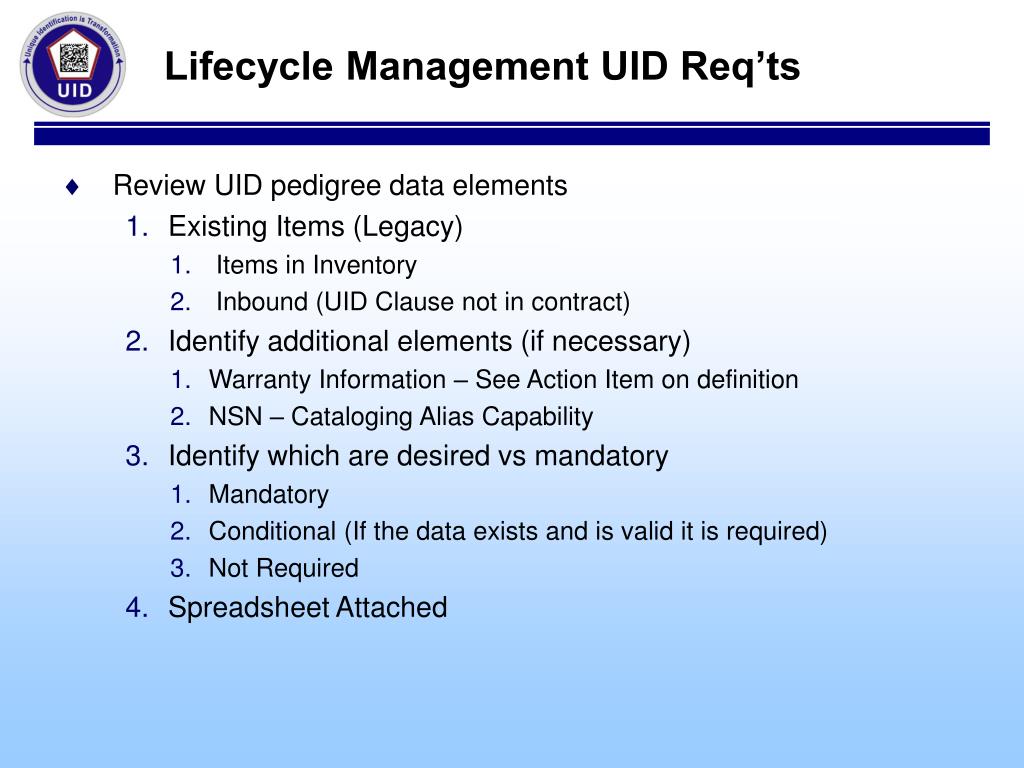
  1. Lifecycle Management UID Req’ts • Review UID pedigree data elements • Existing Items (Legacy) • Items in Inventory • Inbound (UID Clause not in contract) • Identify additional elements (if necessary) • Warranty Information – See Action Item on definition • NSN – Cataloging Alias Capability • Identify which are desired vs mandatory • Mandatory • Conditional (If the data exists and is valid it is required) • Not Required • Spreadsheet Attached

  2. Outline Lifecycle Management issues/ requirements from Logistics perspective • Making the UID Registry an Asset Management or Config Management System is not a good idea. • UID Registry could be used as an Information Broker • Events • Configuration • Ownership (Where do we go to find information about the item) • Installation • Repair • Warranty • Removal • Disposal

  3. Data flow via WAWF • For vendors below prime, parent/child configuration management • Entry point of Data is Primes • There are major issues with configuration management. Industry can deliver as built but it is difficult to maintain with existing DOD maintenance capability

  4. Draft COTS business rules • Did not have expertise in room to address this area.

  5. Action Items • Need UID Trigger Event (for Registry-update) USE Cases (GFP/Valuation working group, Depot IPT, Cataloging/Supply Group, T700, field-level use case: tbd) • Identified a potential GFP serialization problem. Owner “CAGE” plus native serial number on item could result in duplication. (Max) • Need clarification on Marking Legacy Items – Business Rule modification (Nat B.) • Reliable reuse of existing data • Business Rules for duplicates • Greater definition of Warranty Information for registry. Should it be a Warranty flag, or expiration? Where should it be maintained? (GFP WG)

More Related