Climate Simulations in the Late Quaternary: Insights into Past and Future Projections
This study delves into climate simulations during the Late Quaternary, utilizing General Circulation Models (GCMs) such as ECHO-g and Climber-3α, alongside high-resolution Regional Climate Models (RCMs) like MM5. It focuses on reconstructing climate conditions since 1000 AD, examining atmospheric and oceanic components, and analyzing the Late Maunder Minimum. The findings emphasize the importance of understanding historical climate changes to improve future climate predictions, assessing model sensitivities, and enhancing regional climate variability knowledge through integrated simulation approaches.

Climate Simulations in the Late Quaternary: Insights into Past and Future Projections
E N D
Presentation Transcript
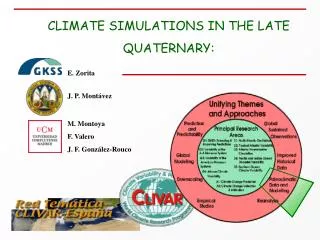
Titulo CLIMATE SIMULATIONS IN THE LATE QUATERNARY: subtitulo E. Zorita J. P. Montávez M. Montoya F. Valero J. F. González-Rouco
Understand the past … to project the future GCM: ECHO-gEMIC: Climber-3αRCM: MM5 Observations Reconstructions Scenario projections Simulation of past scenarios
Climate since 1000 AD • Atmospheric component • (MPI Rep. 218, 1996) • ECMWFMPI • ~ECHAM3 • + fresh water on glaciers • + river runnoff + partial ice cover • T30 ~ 3.75 x 3.75 ºlat x ºlon • 19 vertical levels: • Highest: 10 hPa~ 30 km • Lowest:~ 30 m ECHO-g simulations • Ocean component • (DKRZ Rep. 13, 1997) • Prim. Eq. & Thermodyn. • + sea ice model with snow cover • Gauss. T42 ~ 2.8 x 2.8 ºlat x ºlon • 0.5 ºlat x ºlon Equator • 20 levels
Climate since 1000 AD ECHO-g simulations Zorita et al., GRL, 2005 González-Rouco et al., ESA, 535, 329-338, 2003
Climate since 1000 AD Testing climate reconstructions: GCMS as a surrogate reality Storch et al. Science, 306, 679-682, 2004 González-Rouco et al., GRL, 30, 216, 2003 Zorita et al. J. Climate, 16, 1378, 2003 Zorita & González-Rouco, GRL, 29, 14, 2002
Reconstruction from historical evidence, from Luterbacher et al. Climate since 1000 AD Simulations & reconstructions: Regional view Late Maunder Minimum Model-based simulation Zorita et al. Met. Schr. 13,4, 271-289, 2004 1675-1710vs. 1550-1800
Climate since 1000 AD RCM simulations with MM5 1550-1990 AD • Two way nesting • D1 135 D2 45km • 27 sigma levels (Ptop 100mb) • Nudging • Forcing from ECHO-g 1000 yr • Period 1500-1990 • Output every 6 hours Late Maunder Minimum 1675-1710 vs. 1550-1800
Climate since 1000 AD Winter RCM simulations with MM5 1550-1990 AD Summer Late Maunder Minimum 1675-1710 vs. 1550-1800
GCMs of different complexity Sensitivity to model employed Climer-3α experiments
GCMs of different complexity Montoya et al., Clim. Dyn., 2005 Climber-3a Climer-3α experiments Bauer et al., Paleoceanogr.., 2004 Petoukhov et al., Clim. Dyn.., 2005a Petoukhov et al., Clim. Dyn.., 2005b
GCMs of different complexity Dansgaard-Oeschger and Heinrich events (GRIP) Climer-3α experiments last ice age Holocene (oC)
Context / Outlook • Understanding of the past and reliable prediction of the future requires reconstruction and simulation approaches. • GCMs simulate plausible climate states compatible with external forcing. • Paleo simulations as a framework to study mechanisms which led to relevant climate changes in the past. • GCMs used in IPCC scenario simulations should come to ‘agreement’ with reconstructions of past climate. • Climate simulations as a virtual reality to test methods & hypothesis used in climate reconstructions. • RCMs enhance our knowledge of variability at regional and local scales. • GCMs of different complexity: • Suggesting proccesses and mech., quantify importance Simulation of holocene LGM, abrupt climate change, Climer-3α