Download
1 / 10
100 likes | 235 Vues
This comprehensive guide covers the fundamentals of ionic bonding, providing formulas and names for various ionic compounds like those formed between magnesium and iodine, boron and sulfur, and more. It includes methods to draw Lewis dot diagrams to visualize covalent bonding, explaining the significance of bonding and lone pairs, as well as sigma and pi bonds. The text also addresses naming binary acids and oxyacids, ensuring clarity on how to identify these compounds. A insights into properties of metallic bonds complete this essential resource for chemistry students.

E N D
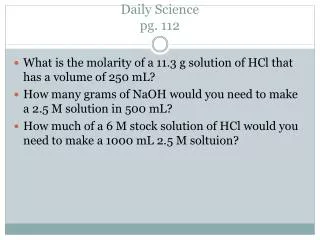
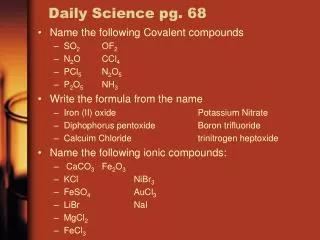
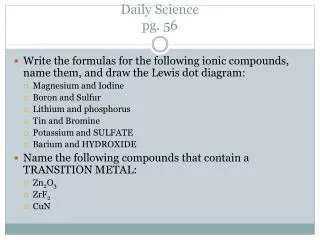
Daily Sciencepg. 56 • Write the formulas for the following ionic compounds, name them, and draw the Lewis dot diagram: • Magnesium and Iodine • Boron and Sulfur • Lithium and phosphorus • Tin and Bromine • Potassium and SULFATE • Barium and HYDROXIDE • Name the following compounds that contain a TRANSITION METAL: • Zn2O3 • ZrF2 • CuN
Metallic and Covalent Bonds Pg. 55
Metallic Bonds Between a metal and a metal Outer energy levels form a ‘sea of electrons’ High melting and boiling points Good conductors Can make alloys (mixture of elements that have metallic properties) Ex. Brass and bronze
Covalent Bonds Non-metal and non-metal Valence electrons are shared Form molecules (2 or more atoms covalently bonded) Use Lewis Structures to show covalent bonds
Lewis Structures and Covalent Bonding • The shared electrons are called bonding pairs • Unshared electrons are called lone pairs • Single bonds in a Lewis structure are called sigma bonds (σ) • Double and triple bonds are called pi bonds (π) • When bonds are broken they either release energy or take in energy • Exothermic- energy is released (feel heat) • Endothermic- Energy is absorbed ( feels cold)
Naming Covalent Bonds • Name the first element first using the whole name • If there is only one of the element name is regularly • If there is more than one of the element use a prefix • The second element ALWAYS gets a prefix and the ending drops and you add –ide • Neither one is capitalized
Examples CCl4 As2O3 CO SO2 NF3
Naming Acids • Always has a Hydrogen attached to it and is always dissolved in water • Naming binary acids: • Only 2 elements • Has a hydrogen atom • Hydro- element or polyatomic ion-ic acid • Naming oxyacids: • A polyatomic ion that contains an oxygen • If the ion ends in –ate change it to –ic • If the ion ends in –ite change it to –ous
Examples HBr HCN HNO3 HNO2