Download
1 / 36
360 likes | 486 Vues
The Hudson River School artists, active from the 1820s to 1870s, exemplified American Romanticism by illustrating the raw beauty of nature and shaping national identity. They portrayed unspoiled landscapes, emphasizing nature as the embodiment of wisdom and fulfillment. Central themes included Transcendentalism, westward expansion, and the moral complexities of civilization's progress. Iconic masterpieces by Thomas Cole, Frederic Church, and Asher Durand reflect these ideals, portraying grand vistas where humanity is often dwarfed by the majesty of nature.

E N D
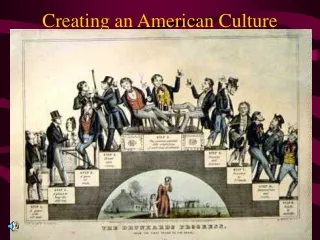
Creating an American Culture Ms. Susan M. PojerHorace Greeley HS Chappaqua, NY
The Hudson River School: 1820s-1870s
The Hudson River School • These artists captured the undiluted power of nature • Paint the nation’s most spectacular and undeveloped areas [the new Garden of Eden]. • Nature was the best source of wisdom & fulfillment. • They created visual embodiments of the ideals of the Transcendentalists.* painting is the vehicle through which the universal mind could reach the mind of mankind.* art is the agent of moral & spiritual transformation.
Characteristics of the Hudson River School “A new art for a new land.” Paint grand, scenic vistas. Humans are an insignificant [even non-existent] part of the picture. Experiment with affects of light on water and sky. Symbol of the school --> a broken tree stump
Issues/Themes Addressed by the Antebellum Artists • Transcendentalist thinking. • Westward expansion. • American nationalism --> What is America?* creation of a national mythology • Racism and Native Americans. • Concern for political extremism. • The price paid for progress and the advances of civilization.
The Course of Empire: The Arcadian or The Pastoral State - Thomas Cole, 1836
Watercolors by John Audubon Stanley Hawk Barred Owl
Fur Trappers Descending the MissouriGeorge Caleb Bingham, 1845
The Classical Styles of Greece & Rome
Patriotic Art
Washington Crossing the DelawareEmmanuel Gottlieb Leutze,1851
The "Frontier" Artists
Young Omahaw, War Eagle, Little Missouri, and Pawnees - Charles Bird King, 1821 1. The “Noble Savage” Image
Buffalo Bull’s Back Fat, Head Chief, Blood Tribe - George Caitlin, 1832 2. The “Stoic” Indian
Mato-Tope – Karl Bodmer, 1830s 3. The “Demonic” Indian
Last of the Race – Tompkins Matteson, 1847 4. The “Doomed” Indian
Dying Indian Chief Contemplating the Progress of Civilization – Thomas Crawford, 1857