Understanding Carbon: Its Unique Bonding Characteristics and Structures
Carbon, with an atomic number of 6, is fundamental to life due to its unique ability to bond. It has four valence electrons and can form various types of bonds, including single, double, and triple bonds. This versatility allows carbon to exist in different forms such as diamonds, graphite, fullerenes, and nanotubes, each with distinct properties. Carbon's special bonding characteristics enable the formation of straight chains, branched chains, and ring structures. Exploring these phenomena provides insights into the importance of carbon in chemistry and its role in complex organic molecules.

Understanding Carbon: Its Unique Bonding Characteristics and Structures
E N D
Presentation Transcript
Carbon chemistry Carbon’s Special Bonding Characteristics
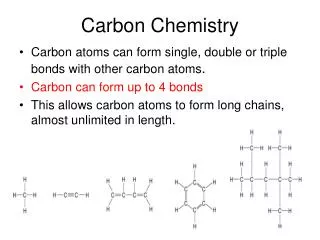
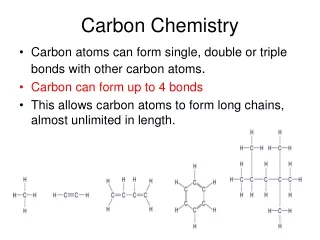
Carbon Atoms and Bonding Carbon’s atomic number is 6 • Carbon can has ____ valence electrons and can form _____ bonds.
Carbon Atoms and Bonding Carbon’s atomic number is 6 Carbon does not lose or gain electrons. • Carbon can has ____ valence electrons and can form _____ bonds. • How does carbon form bonds?
Carbon Atoms and Bonding Carbon’s atomic number is 6 Carbon does not lose or gain electrons. Carbon is central to life. • Carbon can has ____ valence electrons and can form _____ bonds. • How does carbon form bonds? • Describe how carbon is special in its bonding abilities.
Examples of carbon’s bonding structures • In this space, draw some examples of ways carbon can bond and label them: • Straight chain • Branched chain • Ring
Examples of carbon’s bonding structures • In this space, draw some examples of ways carbon can bond and label them:
…break for activity • Take a small scrap of paper and fold it over on itself. • Rub the paper across itself and note how it feels. • Take a second, similar scrap and rub graphite from your pencil over it until you have a large, dark, shiny area. • Fold the paper so that the graphite overlaps itself and rub that part together • Compare the difference between the two papers.
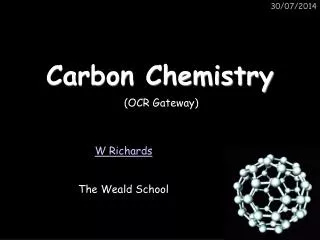
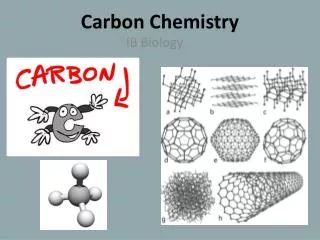
Forms of Pure Carbon • Because carbon can bond in many ways, the pure element carbon can exist in many forms:
Forms of Pure Carbon Ways carbon can bond with itself • Because carbon can bond in many ways, the pure element carbon can exist in many forms: • Diamonds –extremely hard because of bonding in all directions
Forms of Pure Carbon Ways carbon can bond with itself • Because carbon can bond in many ways, the pure element carbon can exist in many forms: • Diamonds –extremely hard because of bonding in all directions • Graphite – slippery because of bonding in layers without strong bonds between layers
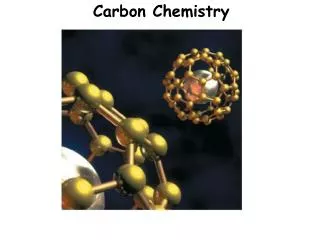
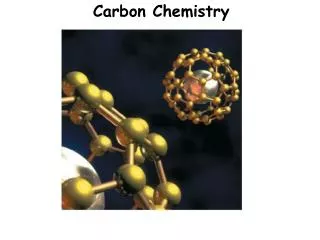
Forms of Pure Carbon Ways carbon can bond with itself • Because carbon can bond in many ways, the pure element carbon can exist in many forms: • Diamonds –extremely hard because of bonding in all directions • Graphite – slippery because of bonding in layers without strong bonds between layers • Fullerine – shaped like a ball
Forms of Pure Carbon Ways carbon can bond with itself • Because carbon can bond in many ways, the pure element carbon can exist in many forms: • Diamonds –extremely hard because of bonding in all directions • Graphite – slippery because of bonding in layers without strong bonds between layers • Fullerine – shaped like a ball • Nanotube – shaped like a tube