An Overview of LNG Transportation and Storage: Challenges and Economic Feasibility
150 likes | 285 Vues
This document explores the intricacies of liquefied natural gas (LNG) transportation and storage, highlighting the increasing demand for natural gas as a reliable and affordable energy source. It covers the technology behind LNG, including cooling methods that reduce natural gas volume, and details the specialized tankers and terminals used. The economic feasibility is discussed alongside the challenges faced in terms of high initial costs and supplier reliability. Finally, it emphasizes the supportive government policies and the ongoing transition towards greater LNG utilization.


An Overview of LNG Transportation and Storage: Challenges and Economic Feasibility
E N D
Presentation Transcript
LNG Transportation and Storage William Guo 10/11/2005
Overview • Introduction • Background • Challenges • Economic Feasibility • Government Policy • Conclusion
Introduction • Increasing natural gas demand and cost • Source for reliable, affordable energy • Relatively mature technology • Cooling natural gas to -260° F, changes it from a vapor into a liquid • Reduces the space natural gas occupies by more than 600 times, making it a practical size for storage and transportation
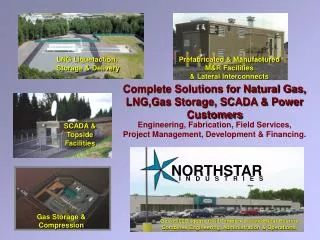
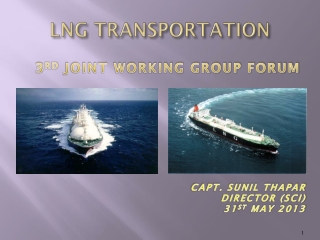
Background • Special designed LNG tankers with double hulls • Ships unload LNG at specially designed terminals where the LNG is pumped to insulated storage tanks • Converted back to gas at the terminal, which is connected to natural gas pipelines • LNG is stored in double-walled, insulated tanks
Challenges • High initial cost ($5 Billion +) • Lack of existing facilities and domestic markets • Supplier reliability • Transportation security
Economic Feasibility • Costs (Two 3 trains facility, 6,500 miles distance, 10 TCF reserve for 20 years) • Source gas: $1.3 Billion • Liquefaction: $1.4 Billion • Transportation: $1.8 Billion • Re-gasification: $0.5 Billion • Feasible with >3,000 mile distance and $5/MSCF outlet gas price
Government Policy • Confirmed supports from federal, state, and local level • FERC’s policy (2002) intends to remove economic and regulatory barriers to the development of onshore LNG import terminals
Conclusion • In transition stage • High potential due to increasing gas demand • Largest risk is supplier stability • Currently only feasible with long transporting distance