Download
1 / 1
10 likes | 119 Vues
This study investigates a psychologist's hypothesis regarding interference and facilitation effects using the Droop task with two colors—control, congruent, and incongruent conditions. Conducted on 24 subjects, the analysis includes a Completely Randomized Design and Repeated Measures Design, examining differences in performance across conditions. Descriptive statistics, figures, and tests of assumptions will be presented. Additionally, the differences between multiple comparison tests: Newman-Keuls, Tukey HSD, and Tukey WHS, will be explored to assess their validity and application contexts.

E N D
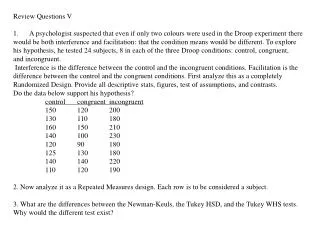
Review Questions V • A psychologist suspected that even if only two colours were used in the Droop experiment there • would be both interference and facilitation: that the condition means would be different. To explore • his hypothesis, he tested 24 subjects, 8 in each of the three Droop conditions: control, congruent, • and incongruent. • Interference is the difference between the control and the incongruent conditions. Facilitation is the • difference between the control and the congruent conditions. First analyze this as a completely • Randomized Design. Provide all descriptive stats, figures, test of assumptions, and contrasts. • Do the data below support his hypothesis? • control congruent incongruent • 150 120 200 • 130 110 180 • 160 150 210 • 140 100 230 • 120 90 180 • 125 130 180 • 140 140 220 • 110 120 190 • 2. Now analyze it as a Repeated Measures design. Each row is to be considered a subject. • 3. What are the differences between the Newman-Keuls, the Tukey HSD, and the Tukey WHS tests. • Why would the different test exist?