Understanding T9 Predictive Text and Trie Data Structures
100 likes | 229 Vues
This document provides insights into T9 predictive text technology, commonly found in cell phones. It explores T9onyms (words generated by T9 input) through examples and the mechanism of ordering these words alphabetically. Additionally, it discusses the data structure known as a Trie, stating its applications in spell checkers and auto-complete features. The assignment challenges students to apply these concepts by implementing T9 using a Trie, optimizing for search efficiency. Extra credit options for more advanced implementations are also addressed.


Understanding T9 Predictive Text and Trie Data Structures
E N D
Presentation Transcript
T9 and Tries CSE 303 Homework 4, Autumn 2008
T9 Predictive Text • What is T9? Demo • T9onyms: • 1. 22737: acres, bards, barer, bares, baser, bases, caper, capes, cards, cares, cases • 2. 46637: goner, goods, goofs, homer, homes, honer, hones, hoods, hoofs, inner • 3. 2273: acre, bard, bare, base, cape, card, care, case • 4. 729: paw, pay, Paz, raw, ray, saw, sax, say • 5. 76737: pores, poser, poses, roper, ropes, roses, sorer, sores • How does T9 order T9onyms? • Assignment Requirement: Alphabetical order • Extra credit options: Frequency, Dynamic Frequency
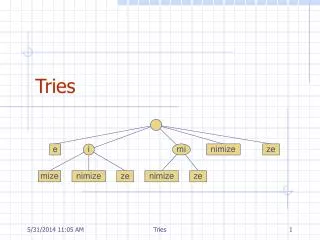
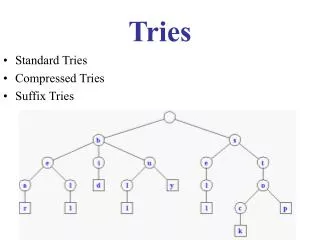
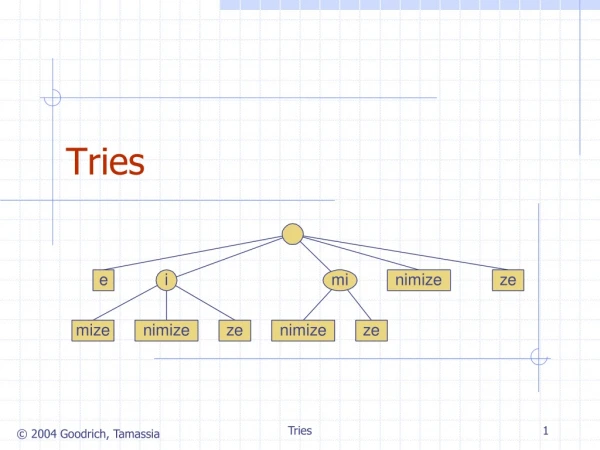
Trie • Tree structure: n-ary tree • We use a trie to store pieces of data that have a key (used to identify the data) from an alphabet • Optionally can also hold a value (which holds any additional data associated with the key). • Applications: • Spell checkers • Auto-complete • Data compression • T9 predictive text input for cell phones • String search
Example: String Search • Goal: • Determine if a given word appears in a block of text. • Optimize for multiple searches in the same block of text • What do we do? • Place each word in the block of text into a data structure • Use data structure to determine whether a word exists in that block of text • Which data structure should we use?
String Search Trie • Text: sells sea shells by the shore [by] [sea] [the] [shore] [sells] [shells]
String Search Trie • Search for: s h e l l s [by] [sea] [the] [shore] [sells] [shells]
Building a Trie for T9 • How is a T9 Trie different? • Alphabet: {2-9} 2 5 3 4 6 7 8 9 2 2 6 3 4 5 8 3 6 9 7 9 5 2 [is] 3 4 9 5 8 6 7 [cap]
Handling T9onyms 2 5 3 4 6 7 8 9 2 2 6 3 4 5 8 3 6 9 7 9 5 2 [is] [car] 3 4 9 5 8 6 7 [cap]
Handling T9onyms 2 5 # 3 4 6 7 8 9 # 2 2 6 3 4 5 8 3 6 9 # 7 9 5 2 [is] 3 # 4 [cap] [car] 9 5 8 6 7 2 3 4 # 5 6 7 8 9
Extra Credit • More accurately implement T9: • Store the prefix of each word in the text file in the trie— - example: foobar- “f”, “fo”, “foo”, “foob”, “fooba”, “foobar” • Order a word in the Trie by its frequency -A word with a higher frequency will be predicted before a lower frequency word. In the text file (listed on assignment), the format of an entry will be word frequency • Update the frequency of a word • Each time a word is used, increment the word’s frequency • Prediction of words should use updated frequencies