Understanding Climate Change Cooperation and the Kyoto Protocol: Key Developments and Challenges
180 likes | 294 Vues
This document delves into the crucial history and mechanisms of international climate change cooperation, focusing on the human-induced increase in greenhouse gases (GHGs) and the role of the Kyoto Protocol. It outlines the scientific foundations of climate change, including historical studies by Svante Arrhenius, and the establishment of the IPCC. The text discusses key agreements such as the UN Framework Convention on Climate Change and various methodologies for emissions reductions, including emissions trading and the Clean Development Mechanism. Challenges and controversies surrounding the Kyoto Protocol's implementation are also addressed.


Understanding Climate Change Cooperation and the Kyoto Protocol: Key Developments and Challenges
E N D
Presentation Transcript
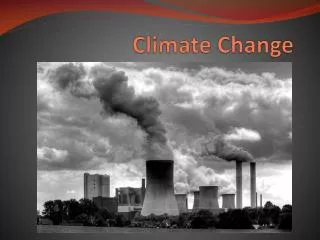
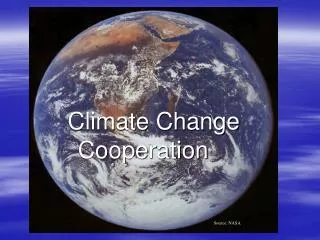
Enter Climate Change Climate Change Cooperation Source: NASA
The Science • Svante Arrhenius (1896) – doubling of CO2 -> increase by 5C • Transnational scientific collaboration: 1970s-1980s • International Panel on Climate Change (IPCC): 1988 by WMO and UNEP
IPCC • Doubling of CO2 • 1.4-5C t increase
Sources of Scientific Uncertainty • Sulfate aerosol – cooling effect • Ocean – absorption capacity • Clouds – cooling or warming effect • Non-linear effect – shutdown of the circulation of the North Atlantic (thermohaline circulations)?
The Breakthrough • UN Framework Convention on Climate Change (Rio 1992) • 189 countries joined • Common but differentiated responsibility • Stabilization at 1990 emission levels desirable • Reporting requirement • GEF: Main funding mechanism
COP at Kyoto • Lead actors: EU reductions of CO2, NOx, methane from 1990 levels • Transition economies: Emissions considerably (~30%) below 1990 levels ->hot air. • US Position: stabilization of all gases at 1990 levels and emissions trading to offset costs, differential targets, participation of developing countries • Canada, Japan, Australia, New Zeeland • Developing countries: industrialized countries should take the lead
The Kyoto Protocol • Emission reduction targets for industrialized countries (Annex I countries) -total emissions -5.2% of 1992 by 2008-2012 -national ceilings -Six gases included (carbon dioxide, methane, nitrous oxide, HFCs, PFCs and sulfur hexafluoride). Global Warming Potentials used to translate to C02 equivalent. • No targets for developing countries • Emissions Trading, Joint Implementation, Clean Development Mechanism (CDM)
COP Bonn and Marrakech • Implementation of flexible mechanisms • Forest sinks – countries can receive credits for carbon sinks (forests) • “Enforcement” mechanisms
Flexible Mechanisms • Emissions trading • Countries with binding emissions trade • Joint Implementations • Country with binding target receives emission credits for emission abatement projects in another country with a binding target • Clean Development Mechanism • Countries with targets receive credits for abatement projects in developing countries – 2% tax for adaptation
Country % of 1990 Annex I E missions US 36 .1 EU 24 .2 Russia 17 .4 Japan n 8.5 Canada 3.3 Poland 3 Other EU 3.4 Acce cession Entry into Force • 55 ratifications • 55% of Annex I emissions http://unfccc.int/resource/kpthermo.html
Two Views on Kyoto Is the KP fatally flawed or is it a meaningful step in the right direction?
Kyoto Protocol Controversies • Hot air • Non-participation • Leakage • Measuring additionally in JI and CDM • Enforcement • “paper” trades • Non-compliance • Exit
Current Developments • Russia ratified 2005 • EU carbon emissions trading projected started January/February 2005 • National allocation plans (cover about 5,000 out of estimated 12,000 large emitters) • Approval of national emission plans • Trade in emission allowances • COP 11, Montreal, November-December 2005 • COP 12, Nairobi, November 2006.