Understanding Genetic Crosses: Monohybrid and Dihybrid Explained
80 likes | 218 Vues
This article explores the fundamentals of genetic crosses, including monohybrid and dihybrid crosses. A monohybrid cross analyzes a single trait, using a simple Punnett square to predict outcomes based on complete dominance, incomplete dominance, and codominance. In contrast, a dihybrid cross evaluates two independent traits with a 16-square Punnett square to show the potential combinations. This resource is essential for anyone interested in genetics, offering clear methods for setting up and interpreting Punnett squares.


Understanding Genetic Crosses: Monohybrid and Dihybrid Explained
E N D
Presentation Transcript
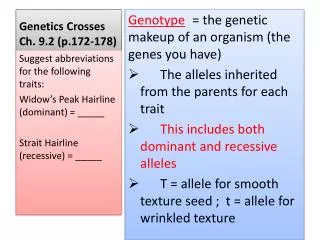
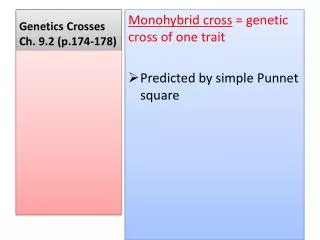
Genetics CrossesCh. 9.2 (p.174-178) Monohybrid cross = genetic cross of one trait • Predicted by simple Punnet square
Genetics CrossesCh. 9.2 (p.174-178) Complete dominance= one allele is completely dominant over the other Incomplete dominance= 2 or more alleles influence the phenotype Codominance = both alleles are expressed in a heterozygous offspring
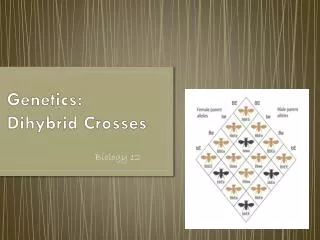
Genetics CrossesCh. 9.2 (p.174-178) Dihybrid cross = cross between individual parents involving two independent traits • Make a 16 square Punnet • Give each column/row one allele for each trait to get the 4 possibilities. (if easier split the traits) • Follow alleles to fill in the Punnet squares How do we write the Punnet square?