Download

1 / 17
170 likes | 291 Vues
This paper evaluates various redirection schemes in Content Distribution Networks (CDNs) and their effects on user-perceived performance. It discusses content delivery methods, including full and selective redirection, and employs simulation models to analyze the impact of bandwidth, latency, and loss rates on download times. Results show that while switching servers can enhance performance under ideal conditions, it often degrades user experience due to server load or inadequate redirection strategies. Future work aims to refine simulation models and assess existing CDN server selection schemes.

E N D
Performance Evaluation of Redirection Schemes inContent Distribution Networks Jussi Kangasharju, Keith W. Ross Institut Eurecom Jim W. Roberts France Telecom R&D
Outline • Content Distribution Networks • Redirection Schemes • Simulations • Experiments • Discussion • Future Work • Conclusion
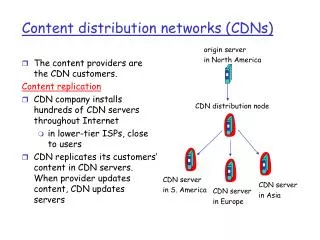
Content Distribution Networks • Content distribution on the Web is changing • Content placed on content servers • Clients redirected to nearby content servers • Better performance for clients • Load balancing on content servers • Better fault tolerance
Redirection Schemes • Full redirection • All client requests directed to content servers • Advantage: Simple • All content servers must be able to serve any content -> full mirrors or proxies • Selective redirection • Only some requests redirected • Need to select what content to serve from content server
DNS Redirection • Currently CDNs use DNS redirection • Two strategies • CDN controls the DNS resource records of the origin server • References to objects are changed to point to a content server • First strategy = Full redirection • Second strategy = Selective redirection
Simulation Model • Use the NS network simulator • Simple model: Client, Server, and Link • Vary RTT, bandwidth, and loss rate on link • Client requests HTML file, then requests images • Look at user-perceived performance (total time) • Does not account for server load (yet)
Effects of Bandwidth • After 1.5 Mbps, download time mostly based on RTT • Study only RTT and loss rate
Different Clients • Two different clients: Pipelining and parallel • Assumption: Parallel client cannot retrieve all objects with one set of connections • Baseline: Retrieve all from origin server • RTTs: 10, 20, 60, 100, 120, and 160 ms • Does not include DNS lookup delay • Assume parallel connections to be independent
Test Files • 100 pages from Hot100.com • Typical homepage 20 KB + 50 KB
Loss Free Network, Baseline • Big gains possible, up to 90%
Loss Free Network, Switch • Parallel connections, Medium page • Gains limited, maximum 30%
Loss in Network, Baseline • Big gains still possible, up to 85% • Not as good as no-loss case (slow-start)
Loss in Network, Switch • Parallel connections, Medium page • Maximum gains 20% (slow-start, loss of SYN)
Experiments • Repeat simulated experiment on Internet • Exclude DNS lookups • Results confirm results from simulations
Discussion • Switching servers limits performance: • Either new server is not fast enough or the client should have used it for all the objects • Easy with full redirection, can be done with selective redirection, but have to be careful • Persistent connections • No server load -> switching degraded • No redirection cost -> switching improved
Future Work • Improve simulation topology and model • Take into account server load in simulations • Include cost of redirection • Perform more extensive experiments • Evaluate the server selection schemes of existing CDNs
Conclusion • Evaluate effects of redirection on user-perceived performance • Both simulations and experiments • Switching servers during download of a page hurts performance • Need to replicate Web pages with images to guarantee best performance