Download
1 / 7
70 likes | 194 Vues
Pulleys are essential simple machines that alter the direction of force and provide mechanical advantages in lifting loads. A fixed pulley changes the force's direction without offering mechanical advantage, while a movable pulley allows for the lifting force to be halved, making it easier to move heavy objects. Combined (double) pulleys enhance this efficiency further by incorporating multiple wheels, which significantly reduce the effort needed for lifting. Understanding these mechanisms can greatly impact construction, rigging, and various engineering applications.

E N D
Fixed Pulley: • Wheel attached to surface • Changes the direction of the applied force • NO mechanical advantage – same amount of force is required
Movable Pulley: • Pulley moves along the rope • Wheel supports the load • Effort is in the same direction as movement • Reduces the forces needed to move an object
In the second picture, the weight is held by two ropes instead of one. That means the weight is split equally between the two ropes, so each one holds only half the weight. http://www.swe.org/iac/LP/pulley_03.html
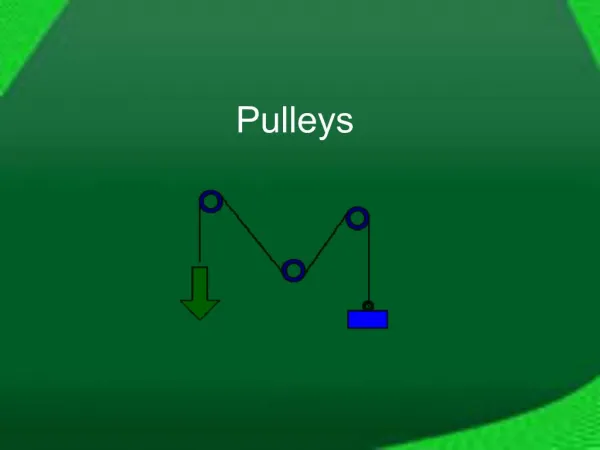
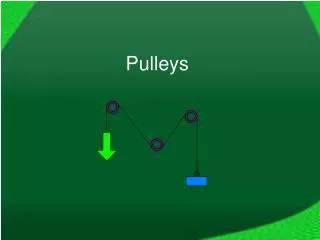
Combined (double) Pulley: • Has at least two wheels • The more complex the pulley, the more the effort needed to move the object decreases
Pulleys are used to gain mechanical advantage trading the amount of rope you have to pull to lift an object for how heavy the object can be.
The more lines of support (ropes) a pulley has, the more mechanical advantage it has! http://www.swe.org/iac/LP/pulley_03.html