
Advancements in Laser-Driven Target Technology at MIT
E N D
Presentation Transcript
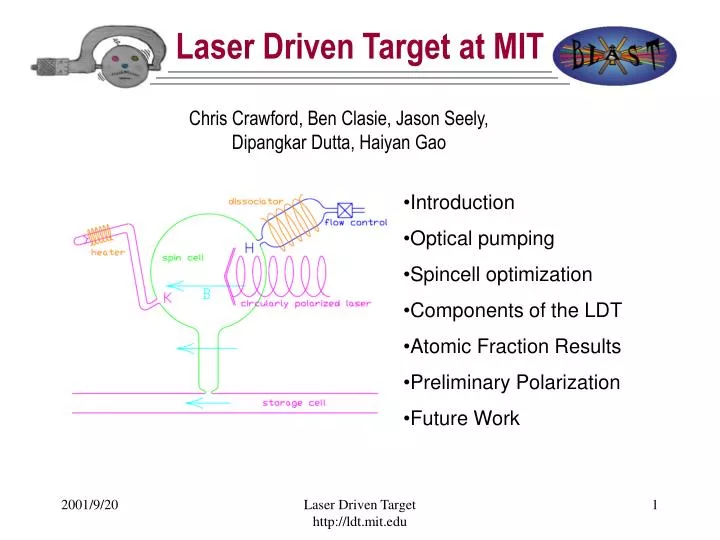
Laser Driven Target at MIT Chris Crawford, Ben Clasie, Jason Seely,Dipangkar Dutta, Haiyan Gao • Introduction • Optical pumping • Spincell optimization • Components of the LDT • Atomic Fraction Results • Preliminary Polarization • Future Work Laser Driven Target http://ldt.mit.edu
Overview • Atomic Beam Source • Well established technology • Can create pure spin states • 8 x 10¹⁶ atoms/s • 84% atomic fraction • 80% polarization • Laser Driven Target • Compact design • Active pumping—higher flux • 2 x 10¹⁸ atoms/s • 60% atomic fraction • 50% polarization Laser Driven Target http://ldt.mit.edu
Optical Pumping At spin temperature equilibrium, the population of each spin state n(mF) is controlled by the Boltzmann equation. Laser Driven Target http://ldt.mit.edu
Spincell Optimization • Developed a code to simulate recombination and depolarization • One must minimize the Surface Area / Volume ratio, and the length of the transport tube Dimensions: 2” diameter spherical spincell with 5 cm neck Laser Driven Target http://ldt.mit.edu
Target Chamber Laser Driven Target http://ldt.mit.edu
Polarimeter Laser Driven Target http://ldt.mit.edu
Sextupole Magnet Laser Driven Target http://ldt.mit.edu
QMA Detector Laser Driven Target http://ldt.mit.edu
Dissociator Trials Laser Driven Target http://ldt.mit.edu
Atomic Fraction Laser Driven Target http://ldt.mit.edu
Preliminary Polarization Laser transmission Laser transmission QMA mass 1 signal QMA mass 1 signal • polarization: 20% (+ helicity) and 23% (- helicity) • polarization preserving mirrors only 87% efficient Laser Driven Target http://ldt.mit.edu
Future Work • Redo polarization tests with correct mirrors. • Fine-tune operational parameters. • Investigate the quality of the spincell coating. • Investigate performance of sextupole filter. • Run tests with deuterium. • Redesign target for operation at BLAST. Laser Driven Target http://ldt.mit.edu