Covered Anaerobic Digester
210 likes | 363 Vues
This case study examines Barham Farms, a modern swine operation in Johnston County, North Carolina, focusing on the implementation of a Covered Anaerobic Digester (CAD) and an Environmental Management System (EMS). The farm, established in 1994 by Julian and Elaine Barham, features efficient waste management systems, including anaerobic lagoons and biogas energy recovery. This initiative shows significant reductions in emissions, improved water quality, and enhanced productivity, providing a replicable model for sustainable agricultural practices in livestock operations.


Covered Anaerobic Digester
E N D
Presentation Transcript
Covered Anaerobic Digester Developing an Environmental Management System (EMS) Approach for Agriculture and Agribusiness Dec. 18, 2000 Julian Barham Barham Farms Zebulon, NC
Case Study - Barham Farm • Located - Johnston County, NC • modern swine farm • populated in 1994 • owned and managed by Julian and Elaine Barham
Background Information • 4000 sow - farrow to wean • 4 gestation barns • 2 farrowing barns • slatted floors (grates) • shallow pit/recharge • flush pit 4/8 day cycle • waste gravity flow
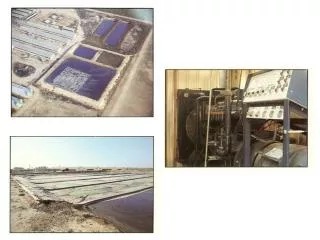
1994 - 1996 Effluent from barns to anaerobic lagoon • 40,000 gallons/day (total solids < 1.0%) • lagoon surface = 6 + acres
Traditional Anaerobic Lagoon Design Evaporation Emissions Field Application Freeboard Rainfall/Storms Storage Treatment Sludge
Covered Anaerobic Digester ? • Odor Control • Energy Resource • Ammonia Emissions • Rainfall Exclusion (*)
Anaerobic Digester and Storage pond Biogas Rainfall Digester effluent Treatment Sludge Anaerobic Digester Storage Pond
Lagoon Cover Design lower cost (?) rainwater into lagoon odor reduction high maintenance • partial cover ? • bank to bank ? rain exclusion no emissions (sealed) biogas storage low maintenance
Things Involved Biogas • Methane + CO2 + H2S • Greenhouse gas Options • Flare • IC Engine • Micro Turbine • Burner/Boiler
Equipment Needed Boiler for hot water - 10,000 gallon hot water storage - hot water for space heating and mats Engine for co-generation - 120 KW for peak shaving - engine heat recovery - hot water
Covered Anaerobic Digester Effluent Organic Carbon - reduced 85% TKN - reduced 30% Total P - reduced 75% K - reduced 20% Ref: ASAE Proceedings 8th InterNatl Symp. Oct 2000 Eval. of Alternat. Waste Sys.
Digester Effluent Use: Apply at agronomic rate to low value hayland!
Digester Effluent Use: Nutrient rich for high value produce in green house environment!
Benefits Seen Biofilter - low energy input process Reduce Ammonia Emissions (NH4 to NO3) Lower pH
Other Results and Conclusion It’s not “A Sows Ear to a Silk Purse” but Demonstrated Energy Resource Reduced Emissions Marketable Produce Manageable System ?