Useful Savings Facts & Formulae
40 likes | 170 Vues
This guide explains the formula for calculating the final amount from a principal when earning compound interest at an annual rate over several years. We illustrate the compound interest formula ( A = P(1 + R)^n ) and provide examples, including investments of £2000 and £6000 at specified rates. We also detail how to calculate the Annual Equivalent Rate (AER) and provide examples, showing how to derive interest earned and future value for different investments.


Useful Savings Facts & Formulae
E N D
Presentation Transcript
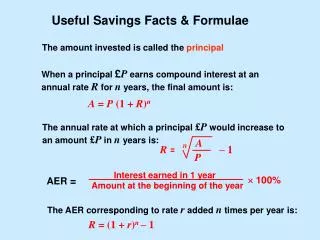
A n R= – 1 P When a principal £P earns compound interest at an annual rate R for n years, the final amount is: A = P (1 + R)n The annual rate at which a principal £P would increase to an amount £P in nyears is: Interest earned in 1 year Amount at the beginning of the year 100% Useful Savings Facts & Formulae The amount invested is called the principal AER = The AER corresponding to rate r added n times per year is: R = (1 + r)n – 1
4.2 R= = 0.042 100 A = P (1 + R)n Example Neil invests £2000 at 4.2% per annum. Calculate the amount after 10 years. A = 2000(1 + 0.042 )10 = 2000x 1.04510 = 3017.916… Amount = £3017.92 (nearest pence)
Interest earned in 1 year b) AER = 100% Amount at the beginning of the year 256.91 = 100% 6000 Kate invests £S at 0.35% per month. Example The amount after nyears isP = S 1.0035 12n a) Kate invests £6000. Find the amount at the end of 1 year. b) Hence find the AER. a) P= 6000 1.003512 = 6256.908… Amount at the end of 1 year = £6256.91 (nearest pence) AER = 4.28%
A n R= – 1 P – 1 4 = 4 4600 – 1 1.31428... R = 3500 – 1 1.07071... = Example An investment of £3500 has grown to £4600 in 4 years. Find the annual percentage rate of interest. = 0.07071... Annual % rate = 7.07% (to 3 sf)