Download
1 / 4
40 likes | 168 Vues
This article explains the key differences between megabytes (MB) and megabits (Mb). While MB is a measure of data storage, where one megabyte equals 1,048,576 bytes, Mb refers to data transfer rates, with one megabit equaling 1,000,000 bits. We delve into concepts like kilobytes (KB), gigabytes (GB), and their implications for understanding internet speeds and storage capacities. Additionally, we clarify how to convert between these measurements, providing practical examples for better comprehension.

E N D
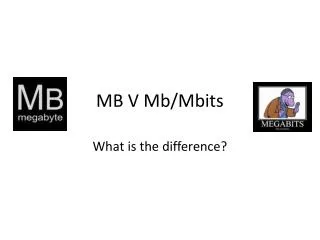
MB V Mb/Mbits What is the difference?
The difference? MB • One is a measure of data storage • Byte 8 bits, 1 ASCII encoded text. • Kilobyte KB or K • Text in Chapter 2 in Beekman reflects 169K of data • Megabyte or meg or MB • Gigabyte or gig or GB • The other is a measure of Data Transfer
Mb • The other is a measure of Data Transfer or memory size • A megabit is 1,000,000 bits • 1/8 the size of a meagbyte
MBps = Megabytes Per Second.Mbps = Megabits Per Second.1Byte = 8 Bits1MBps = 8MbpsExample:21Mbps = (21/8)MBps = 2.625MBps