Understanding Proportions and Similar Figures in Geometry
120 likes | 223 Vues
This guide helps students apply their knowledge of proportions to solve geometric problems. It covers the concepts of similar and congruent figures, detailing how to determine proportional relationships between corresponding sides and angles. The discussion includes practical examples, such as determining the height of a tree using similar triangles based on shadow lengths. Through step-by-step solutions, learners will refine their skills in solving for unknown variables in proportion equations and recognize the significance of angle congruence in similar figures.


Understanding Proportions and Similar Figures in Geometry
E N D
Presentation Transcript
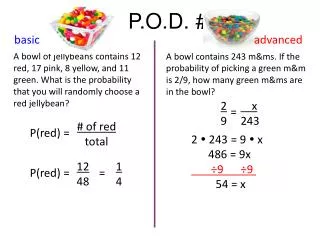
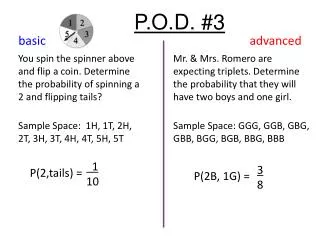
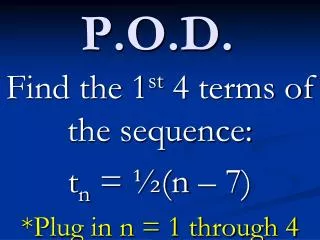
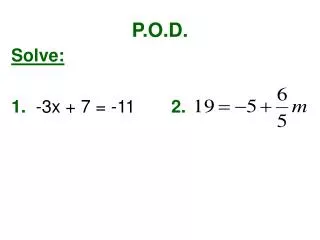
P.O.D. #4 advanced basic Use your knowledge of proportions to solve for x. Use your knowledge of proportions to solve for t. 3 8 x 24 8.5 3 12.75 t = = 3 24 = 8 x 72 = 8x ÷8 ÷8 9 = x 8.5 t = 3 12.75 8.5t = 38.25 ÷8.5 ÷8.5 t = 4.5
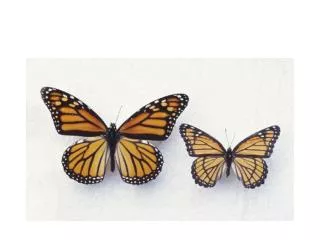
Figures that have the same shape but not necessarily the same size are called similar figures.
When two figures are similar, their corresponding sides are in proportion. 4 8 1 2 = 3 6 1 2 = 8 10 5 10 1 2 = 4 5 6 3 This means the ratios of the lengths of the corresponding sides are equal.
The corresponding angles of similar figures are congruent. This means the corresponding angles have the same measure. 30° 30° 90° 60° 60° 90°
Figures that have the same shape AND size are called congruent figures. When two figures are congruent, the corresponding sides are congruent AND the corresponding angles are congruent.
Whiteboard: 6 9 6 9
Whiteboard: 1 4 1 1 4 3 ≠ 1 3
Whiteboard: 3 2 x 9 3 2 9 x = 3x = 29 3x = 18 ÷3 ÷3 x = 6
Whiteboard: Old Faithful in Yellowstone National Park shoots water 60 feet into the air that casts a shadow of 42 feet. What is the height of a nearby tree that casts a shadow 63 feet long? Assume the triangles are similar. 63 60 = 42 x 3780 = 42x ÷42 ÷42 90 = x 63 42 x 60 =