Strategies for Funding Accessible Transport: Integrating Long-Term Planning and Incentives
This discussion focuses on innovative methods for incorporating funding for improved accessibility into long-term transport planning. It explores ways to break the traditional silo approach to funding, identifying cross-sector benefits such as healthcare cost reduction from increased mobility, and how governments can facilitate this. Additionally, the text examines potential fiscal incentives to stimulate investment in accessible transport and proposes strategies, including penalties and incentives, to ensure that accessibility is a fundamental component of transport investment.

Strategies for Funding Accessible Transport: Integrating Long-Term Planning and Incentives
E N D
Presentation Transcript
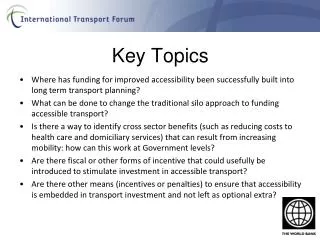
Key Topics • Where has funding for improved accessibility been successfully built into long term transport planning? • What can be done to change the traditional silo approach to funding accessible transport? • Is there a way to identify cross sector benefits (such as reducing costs to health care and domiciliary services) that can result from increasing mobility: how can this work at Government levels? • Are there fiscal or other forms of incentive that could usefully be introduced to stimulate investment in accessible transport? • Are there other means (incentives or penalties) to ensure that accessibility is embedded in transport investment and not left as optional extra?