CS2223 Recitation Pointer sort -- an Adaptation of Quick Sort
140 likes | 325 Vues
CS2223 Recitation Pointer sort -- an Adaptation of Quick Sort. by Song Wang. Motivation. Be familiar with the quick sort algorithm Indexed data sorting Calling stack minimization for recursive function call. Problem Definition.


CS2223 Recitation Pointer sort -- an Adaptation of Quick Sort
E N D
Presentation Transcript
CS2223 RecitationPointer sort--an Adaptation of Quick Sort by Song Wang
Motivation • Be familiar with the quick sort algorithm • Indexed data sorting • Calling stack minimization for recursive function call
Problem Definition • Given an array has a key field and data field, return the array sorted by the key value. • Eg. Note: Key value is unique in the whole column
Pointer Sort (or Index Sort) • Instead of moving large records, we build an array of pointers (an index) to do the swap. • Eg. • Frequently used for huge table sorting, e.g. for relational database table. Sorted Initial
Code--by Gonnet and Baeza-Yates #include <sys/types.h> #include <sys/wait.h> #include <limits.h> #include <stdio.h> #include <stdlib.h> #include <sys/time.h> #include <sys/resource.h> #define TIMEBASE 699940000.0 struct timeval tp; struct timezone tzp; #define N 100 double sec1, sec2; int depth = 0, m=5, ip, ip1;
Code (Cond.)--by Gonnet and Baeza-Yates main() { int *r, *pr, b=0, e=N-1, s,t, i; //prepare array if ( (r=(int *)malloc( 4*(N+1))) == NULL) {printf("allocation failed\n"); exit(2); } if ( (pr=(int *)malloc( 4*(N+1))) == NULL) {printf("allocation failed\n"); exit(2); } srandom(2934); for (s=0;s<N;s++) {pr[s]=s; r[s] = random()%1000;} Size of int Initialize all pointers Each key value is [0,1000) Easy to read the printouts
Code (Cond.)--by Gonnet and Baeza-Yates //calling quick sort pointer function gettimeofday(&tp, &tzp); sec1 = tp.tv_sec + tp.tv_usec/1000000.0; qsp(r, pr, &b, &e); gettimeofday(&tp, &tzp); sec2 = tp.tv_sec + tp.tv_usec/1000000.0; printf("qs time %f\n", sec2-sec1); //calling insertion sort pinsort(r,pr, N); gettimeofday(&tp, &tzp); sec1 = tp.tv_sec + tp.tv_usec/1000000.0; printf("insort time %f\n", sec1-sec2); Begin index &end index
Code (Cond.)--by Gonnet and Baeza-Yates //checking sorted array for (i=0; i<N-1;i++) if (r[pr[i]] > r[pr[i+1]]) printf("out of order at %d\n",i); } Note: Checking the order is of course only needed until the code is accepted as correct,
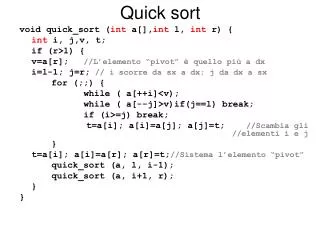
Code (Cond.)--by Gonnet and Baeza-Yates threshhold int qsp(int *r, int *pr, int *b, int *e){ int i ,j ,p, pb, t, ab, ae; while ( (*e)- (*b)>m ) { //find the pivot i = *b; j = *e; pb = pr[(*b)]; p = r[pr[(*b)]]; while (i<j) {while (r[pr[j]] > p) j--; pr[i] = pr[j]; while ( (i<j) && (r[pr[i]] <= p) ) i++; pr[j] = pr[i]; } pr[i] = pb; pb,p used for swap later Pivot at i
Code (Cond.)--by Gonnet and Baeza-Yates //recursive call qsp() for both portions if (i-*b < *e -i) { ae = i-1; qsp(r,pr,b,&ae); *b = i+1;} else { ab = i+1; qsp(r,pr,&ab,e); *e = i-1;} }//for while (i<j) }//for qsp Discussed later: Call stack minimization
Code (Cond.)--by Gonnet and Baeza-Yates // perform once a straight insertion sort pinsort(int *a, int *pr, int n) { int i,j, tj; int t; if (n <= 1) return; for (j=1; j<n; j++) { tj = pr[j]; t = a[pr[j]]; for (i=j-1; i>=0; i--) if(t < a[pr[i]]) pr[i+1] = pr[i]; else break; pr[i+1] = tj; } }
A Running Example r N=9 0 1 2 3 4 5 6 7 8 pr Initialize qsp(r, pr, 0, 8); j i pb = 0; p =13 j i
A Running Example (Cond.) r N=9 0 1 2 3 4 5 6 7 8 j i j i i Recursive call Recursive call
Call Stack Minimization if (i-*b < *e -i) { ae = i-1; qsp(r,pr,b,&ae); *b = i+1;} else { ab = i+1; qsp(r,pr,&ab,e); *e = i-1;} • First recursively qsp() shorter partition. • Why? • The worst case: the pivot is always the biggest element • Call left partition first will need O(n) call stack depth