Download
1 / 8
80 likes | 237 Vues
SWI-Prolog Portable is a versatile tool that allows users to run Prolog applications without installation. It supports development in logic programming, enabling functionalities such as querying databases, defining rules, and executing queries. With features like trace debugging, factorial calculations, and list operations, it’s an ideal environment for both beginners and advanced programmers. The integrated learning resources provide additional support in mastering Prolog syntax and logic, facilitating easier understanding and application of programming concepts.

E N D
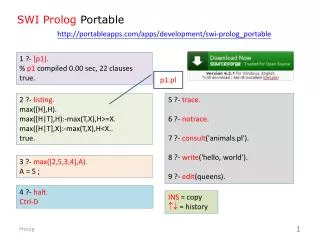
SWI Prolog Portable http://portableapps.com/apps/development/swi-prolog_portable • 1 ?- [p1]. • % p1compiled 0.00 sec, 22 clauses • true. p1.pl 2 ?- listing. max([H],H). max([H|T],H):-max(T,X),H>=X. max([H|T],X):-max(T,X),H<X.. true. 5 ?- trace. 6 ?- notrace. 7 ?- consult('animals.pl'). 8 ?- write('hello, world'). 9 ?- edit(queens). 3 ?- max([2,5,3,4],A). A = 5 ; 4 ?- halt. Ctrl-D INS= copy = history
father Facts事實 david+amy jack+karen sunny. father(john, peter). father(john, mary). father(david, liza). father(david, john). father(jack, susan). father(jack, ray). mother(susan, peter). mother(susan, mary). mother(amy, liza). mother(amy, john). mother(karen, susan). mother(karen, ray). X liza john+susan ray T peter mary Y and if Rules規則 yeye(X, Y) :- father(X, T), father(T, Y). mama(X, Y) :- mother(X, T), father(T, Y). gunggung(X, Y) :- father(X, T), mother(T, Y). popo(X, Y) :- mother(X, T), mother(T, Y). Goals目標、 Queries查詢 ? yeye(david,peter). yes ? yeye(A,peter). david ? yeye(david,A). peter, mary
SWI Prolog Portable factorial(5) = 54321 • factorial(0,1). factorial(N,F) :- N>0, N1 is N-1, factorial(N1,F1), F is N*F1. factorial(0) = 1 factorial(N) = F ifN>0 &&N1 is N-1, &&factorial(N1) = F1, &&F is N*F1. or factorial(3,X). factorial(3,F) :- 3>0, N1 is 3-1=2, factorial(2,F1), F is 3*F1. factorial(2,F) :- 2>0, N1 is 2-1=1, factorial(1,F1), F is 2*F1. factorial(1,F) :- 1>0, N1 is 1-1=0, factorial(0,F1), F is 1*F1. 2 1 3*2=6 • factorial(0,1).
SWI Prolog Portable Queries查詢 Don’t care Rules規則 H H first([H|_],H). last([H],H). last([_|T],X) :- last(T,X). first([1|2,3,4],X). X=1 R1 R2 T R1 or R2 last([1|2,3,4],X). last([2|3,4],X). last([3|4],X). last([4],X). R1 X=4
max([H],H). max([H|T],H):- max(T,X), H>=X. max([H|T],X):- max(T,X), H<X. R1 • His max, if Only 1 element left • His max, if • X is max(T) • and H>=X • Xis max, if • X is max(T) • and H<X • 只有1個元素 • X = max(Tail) • Head >= X • X = max(Tail) • X > Head R2 R3 • max([3,1,4,2],H). R2 H | T • max([3|1,4,2],3):- • max([1,4,2],X) • 3>=X R2 H | T • max([1|4,2],H):- • max([4,2],X) • 1>=X H | T R2 • max([4|2],H):- • max([2],X) • 4>=X 4 false R1 4 H | T 4 false R3 • max([3|1,4,2],X):- • max([1,4,2],X) • 3<X 2 H | T R3 • max([1|4,2],X):- • max([4,2],X) • 1<X H | T R3 • max([4|2],X):- • max([2],X) • 4<X 4 R1 4 • SWI Prolog Portable 2 false
X T R1 R2 insert(X,T,[X|T]). insert(X,[H|T],[H|NT]):- insert(X,T,NT). 加在 head 加在 tail H X T • P=[1, 2, 3] • P=[2, 1, 3] • P=[2, 3, 1] Query? insert(1,[2,3],P). • P=[1, 2, 3] X, T, [X|T] R1 insert(1,[2,3],[1|2,3]). • P=[2, 1, 3] X,[H|T],[H|NT] insert(1,[2|3],[2|NT]):- insert(1,[3],NT). • R2 R1 X,[T] • NT = [1,3] • [3,1] • R2 X,[H|T],[H|NT] insert(1,[3],[3|NT]):- insert(1,[ ],NT). • NT = [1] X,[T] R1 • P = [2, 3, 1] • SWI Prolog Portable • R2 fail
DSE2012 Q.4(c) 事實 體育 (sports) 學會 音樂 (music) 學會 棋藝 (chess) 學會 美術 (art) 學會 長笛 (flute) 組 雙簧管(oboe) 組 籃球 (basketball) 組 程式子句 belongsto(sports, union), belongsto(music, union). belongsto(chess, union). belongsto(art, union). belongsto(flute, music). belongsto(oboe, music). belongsto(basketball, sports). 屬於學生會union 屬於學生會 屬於學生會 屬於學生會 屬於音樂學會 屬於音樂學會 屬於體育學會 規則 若X屬於 學生會,它便是一個學會。 若X屬於一個學會,它便是一個組別。 程式子句 club(X):- belongsto(X,union). group(X):- belongsto(X,Y) & club(Y). Clubs Groups
以下的例子是一些查詢的結果。 (i) 下列查詢的結果是什麼? 查詢 ?- belongsto(chess, union). ?- belongsto(science, union). ?- club(A). (1) ?- group(volleyball). (2) ?- belongsto(B, music). (3) ?- group(C). (ii) 寫出尋找美術學會所屬組織的查詢。 • 結果? (iii) 與過程語言(C)比較,使用邏輯語言(prolog,lisp)有什麼好處? Animal Identification http://www.csupomona.edu/~jrfisher/www/prolog_tutorial/2_17.html Queens http://www.csupomona.edu/~jrfisher/www/prolog_tutorial/2_11.html http://www.csupomona.edu/~jrfisher/www/prolog_tutorial/contents.html Blocks World http://www.csupomona.edu/~jrfisher/www/prolog_tutorial/2_19.html on(a,b). on(b,c). on(c,table).