Programming cells by mutliplex genome engineering and accelerated evolution
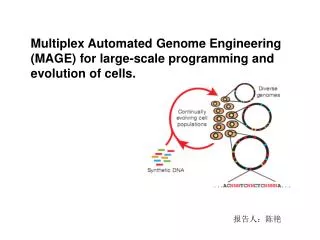
This paper discusses MAGE (Multiplex Automated Genome Engineering) technology, which enables large-scale genome modifications with high efficiency. MAGE utilizes automated methods to incorporate ssDNA oligos into the lagging strand of the replication fork, allowing for genetic modifications in about 30% of cells every 2 to 2.5 hours. The efficiency of mismatches, insertions, and deletions depends on the amount of homologous sequence and free energy between the oligo and chromosome. The study highlights how adjusting oligo diversity can rationally influence mutation rates and optimize traits like lycopene production.

Programming cells by mutliplex genome engineering and accelerated evolution
E N D
Presentation Transcript
Programming cells by mutliplex genome engineering and accelerated evolution Harris H. Wang, Farren J. Isaacs, Peter A. Carr, Zachary Z. Sun, George Xu, Craig R. Forest, George M. Church Raven Reddy March 30, 2011
MAGE Technology • Wanted to modify genomes on large, parallel scale • Automated method to modify many locations • Incorporate ssDNAoligos onto lagging strand of replication fork • Create genetic modifications in 30% of cells every 2-2.5 hrs
Quantifying Efficiency • Mismatch or Insertion efficiency proportional to amount of homologous sequence
Quantifying Efficiency • Deletion efficiency proportional to size of deletion
Quantifying Efficiency • Hybridization free energy between oligo and chromosome predicts replacement efficiency
Generating Sequence Diversity 30 consecutive mutations 6 consecutive mutations 6 interspersed mutations
Conclusions • Created adjustable diversity with MAGE • Rationally designed oligos can have specific effects • Oligos with degenerate sequences create diversity • Accelerates the rate of accumulation of useful mutations
Generating Sequence Diversity • Complexity of the oligo pool • Number of loci targeted • Number of MAGE cycles performed