Download
1 / 14
140 likes | 256 Vues
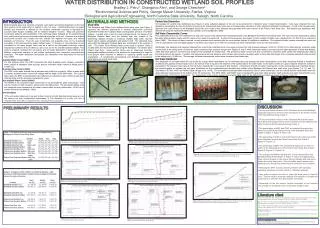
This study investigates whether the substrate in a volunteer wetland acts as a sink for soluble metals from mine water discharge. Comprehensive field and laboratory methods were employed, including sample collection using auger and slide hammer techniques, and analysis of pH, moisture content, bulk density, and total metal concentrations. Results indicated elevated surface iron concentrations while subsurface levels aligned with background levels. Zinc concentrations mirrored those of iron. These findings highlight the wetland's potential for long-term metal retention, guiding future metal analysis research.

E N D
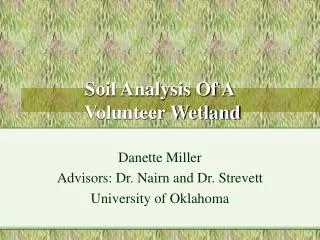
Soil Analysis Of A Volunteer Wetland Danette Miller Advisors: Dr. Nairn and Dr. Strevett University of Oklahoma
Overview • Importance of substrate • Field methods • Laboratory methods • Analysis • Results • Conclusions
Substrate • Sink • Long term retention of metals • Types • Organic • Mineral
Problem Statement • Is the substrate in the volunteer wetland a sink for soluble metals in the mine water discharge?
Field Methods • Sample collection • Auger, slide hammer, manual extraction • Replicates • Sample storage
Laboratory Methods • pH • Moisture content • Particle density • Pore space • Bulk density • Total metals • Microwave Digestion • AA spectrophotometer
Results • pH • 6.08 to 7.56 • Moisture content • Surface: 55% to 86% • Subsurface: 25% to 42% • Particle density • Surface: 0.26 to 0.56 g/cm3 • Subsurface: 0.27 to 0.57 g/cm3
Results • Bulk Density • Surface: 0.3 to 0.6 g/cm3 • Subsurface: ND • Total metals • Stratified trends
Conclusions • Substrate is a sink • Trends • Surface iron concentrations are elevated • Subsurface iron concentrations are similar to background levels • Zinc trends were similar to iron trends
Future Research • Additional metals • Pb, Cd • Available metals • metal concentration available for biomass uptake
Acknowledgements • NSF • Dr. Nairn and Dr. Strevett • REU lab research crew • Carrie Evenson and Jane Sund • Jacob Manko and Todd Wolfard • Erin Breetzke and Lisa Hare • Sharon and Janna Robbins • Wetland Willy