Download
1 / 2
20 likes | 134 Vues
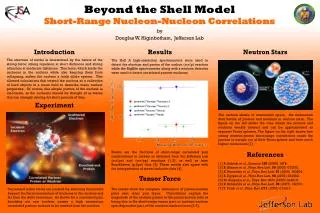
This project investigates the nucleon spectrum using variational methods at a pion mass of 620 MeV, classifying states according to their lattice symmetries. It includes a proof-of-concept calculation as part of a larger full QCD initiative. The research encompasses three phases, with increasing volumes and decreasing pion masses, aiming to calculate low-lying excited baryon resonance masses, decay widths, and nucleon form factors. The computational costs range from 1.2 to 36 Tflop-yrs, facilitating advanced studies in lattice quantum chromodynamics.

E N D
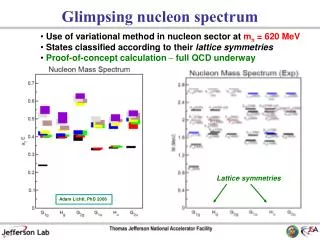
Glimpsing nucleon spectrum • Use of variational method in nucleon sector at m = 620 MeV • States classified according to their lattice symmetries • Proof-of-concept calculation – full QCD underway Lattice symmetries Adam Lichtl, PhD 2006
Lattice Opportunities Spectrum project of LHPC • Phase I – Volumes to 3.2fm boxes, smallest pion mass is 220 MeV • Lowest-lying nucleon resonances • Cost of calculation = 1.2 Tflop-yr • Phase II – Volumes to 4.0fm, pion masses to 200 MeV • Several (more than 2 or 3) low-lying excited baryon resonance masses with decay widths, nucleon form-factors • Cost of calculation = 7.2 Tflop-yr • Phase III – Volumes to 4 fm, three lattice spacings, pion masses down to 180 MeV • Resonance masses in continuum limit, nucleon form-factors Q2 > 10 GeV2, N- and Roper transition form factors • Cost of production = 36 Tflop-yr DOE INCITE Award