DNA Replication
DNA replication is essential when cells divide, ensuring that each new cell inherits a complete set of genetic information. During Interphase of Mitosis and Meiosis, DNA strands are unzipped by the enzyme helicase, creating replication bubbles. Each parent strand serves as a template for synthesizing complementary daughter strands, facilitated by DNA polymerase. This process is semi-conservative as one parent strand is conserved in the new DNA molecules. DNA is crucial for storing instructions for protein synthesis, which ultimately defines the organism.

DNA Replication
E N D
Presentation Transcript
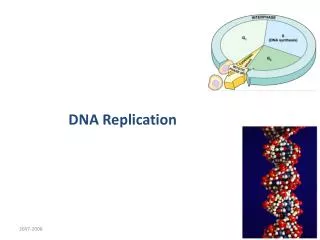
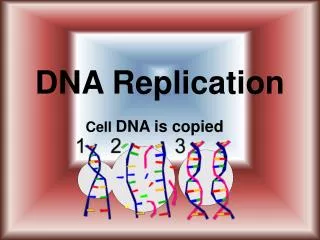
Why is DNA Replication needed? • When cells are dividing… • During Interphase of Mitosis & Meiosis DNA must be copied so that each new cell has a full copy of the DNA • Either to GROW or make gametes
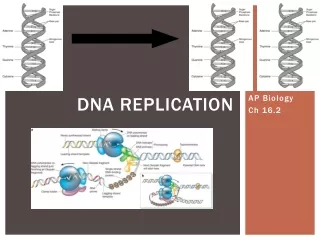
Starting DNA Replication • The two strands of DNA are unzipped by an enzyme called HELICASE • The hydrogen bonds between the nitrogen bases are broken • Creates a replication bubble • Each strand is now called a “parent strand”
DNA Replication • Each “parent strand” is used as a template to make the strand they are missing • This is called the complementary daughter strand of DNA • To make the daughter strand complementary nucleotides are added to the bases of the parent strand • The enzyme DNA polymerase does this
DNA Replication • Once the bases are paired the sugar & phosphate groups are linked together • The bases are “proof read” • We now have 2 copies of DNA!!
Semi-Conservative Replication • Because 1 parents strand is used to make the daughter strand DNA replication is called semi-conservative…1 parent strand is conserved and joins the newly synthesized complementary strand to form the new double helix!
Why is DNA important? DNA holds all of the instructions for what proteins to make and when to make them 1. DNA is composed of segments called GENES a. each gene codes for a protein b. proteins make you who you are