Comprehensive Guide to Evidence in Operational Auditing
This guide provides a deep insight into the essential attributes and types of evidence required for effective operational auditing. Focusing on the sufficiency, competence, relevance, and usefulness of evidence, it outlines methodologies established in advance and emphasizes the importance of documentation and supervision. It covers various evidence collection procedures, including interviews, recomputation, and statistical sampling. Additionally, it highlights the necessity of clear working papers, efficient testing strategies, and comprehensive review processes to ensure reliable audit conclusions.

Comprehensive Guide to Evidence in Operational Auditing
E N D
Presentation Transcript
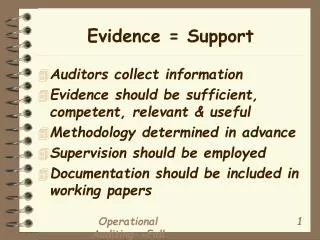
Evidence = Support • Auditors collect information • Evidence should be sufficient, competent, relevant & useful • Methodology determined in advance • Supervision should be employed • Documentation should be included in working papers Operational Auditing--Fall 2001
Attributes of Evidence • Sufficient: convincing • Competent: reliable • Relevant: consistent with objectives • Useful: goal oriented Operational Auditing--Fall 2001
Types of Evidence Based on Procedure • Interviews • Recomputation • Detailed testing • Observation • Scanning • Statistical sampling • Confirmation • Analytical procedures Operational Auditing--Fall 2001
W/P Documentation-Introduction • Efficient • Able to stand-alone • Clear • Relevant Operational Auditing--Fall 2001
W/P Model • Audit program summarizes the work • Documentation and evidence supports the conclusions Operational Auditing--Fall 2001
Supervision • Audit staff instruction • Individual work review • Working paper review • Report review • Audit objective assurance Operational Auditing--Fall 2001
Expanded Testing Purposes • Detailed review • Compliance testing • System or performance evaluation • Exh. 9-1 (p. 365): examples Operational Auditing--Fall 2001
Expanded Testing Criteria • Directly related to the risk examined • Efficient in design • Feasible with respect to the auditors’ abilities Operational Auditing--Fall 2001