Download
1 / 15
150 likes | 258 Vues
This study investigates the impact of power supply scaling on fault tolerance and power dissipation in distributed embedded systems. The architecture consists of heterogeneous processing elements and examines energy and reliability models in task scheduling. Through advanced optimization strategies, including a TABU search-based algorithm, we explore the trade-offs between energy consumption and reliability while ensuring tasks meet timing requirements. Our findings suggest that careful consideration of these trade-offs can mitigate the negative effects of energy minimization on system reliability.

E N D
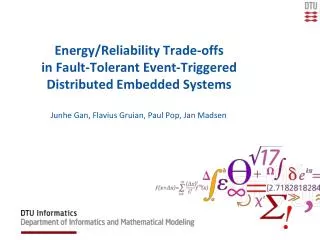
Energy/Reliability Trade-offs in Fault-Tolerant Event-Triggered Distributed Embedded Systems Junhe Gan, Flavius Gruian, Paul Pop, Jan Madsen
Motivation The impact of power supply scaling on fault-tolerance (MTTF) and power dissipation Maheshwari, A. et al., Trading off transient fault tolerance and power consumption in deep submicron (DSM) VLSI circuits , VLSI Systems, pp. 299-311, 12(3), 2004.
Outline • Architecture, Application and Energy Models • Reliability model • Energy/reliability trade-off model • Schedulability analysis • Problem Formulation • Example • Optimization Strategy • TABU search-based algorithm • Experiment Results • Conclusion and Contributions
Architecture Model • A set of heterogeneous Processing Elementsinterconnected by a communication channel. • Each PE has a set of operating mode • Each operating mode, we know
Reliability Model K = 2 N1 t1 N2 t1 N3 t1 Replication:Transient faults /Permanent faults t1 t1 t1 Re-execution:Transient faults
Energy and Application Model Sum of mode-switching overheads • Application Model: • A set of periodic tasks • for each task, we know • Unique priority • Critical/non-critical task • Energy Model:
Energy/reliability Trade-off Model The average failure rate of a system increases exponentially when the supply voltage and the operating frequency decreases
Schedulability Analysis Fixed-Priority Preemptive Scheduling Response Time Analysis Degree of Schedulability
Problem Formulation • Given: • Application • Architecture • Reliability Goal • Tolerate k-faults for each task • We are interested to determine: • the mapping for allocating each task • the operating mode for executing each task • Such that: • all tasks meet their timing requirements • the application reliability meets the given reliability goal • the energy consumption of system is minimized
Optimization Strategy Energy Consumption TimingRequirement ReliabilityGoal • NP-hard problem: • ways of allocating tasks to PEs. • ways of executing tasks at operating modes of an PE. • Search the optimal solution by heuristic algorithm. • Minimize the cost function:
Tabu Search-based Algorithm Design Transformations Use and Maintenance ofTabu-list Searching Loop:
Conclusion and Contributions It is possible to eliminate the negative impact of energy minimization on reliability by carefully considering the energy/reliability trade-offs during optimization. • Conclusion: • Contributions: • Energy/reliability model • Combine deciding mapping and operating mode assignment • Optimization algorithms for this energy/reliability trade-offs problem