Analysis of Detector Background Occupancy Limits and Particle Contributions
This document outlines the background occupancy limits and particle interactions within two types of detectors: LCcal and Shashlik. It discusses the assumed number of channels and provides estimated values for muons, hadrons from minijets, photons, and Radiative Bhabhas collisions. The analysis considers a pessimistic scenario to evaluate occupancy levels and potential contributions from particles like muons (6/BX in LCcal and 3.4/BX in Shashlik) and hadrons (100 GeV/BX in Shashlik). This data is essential for understanding detector performance and background management.

Analysis of Detector Background Occupancy Limits and Particle Contributions
E N D
Presentation Transcript
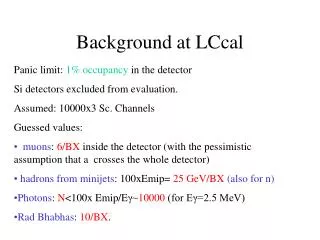
Background at LCcal • Panic limit: 1% occupancy in the detector • Si detectors excluded from evaluation. • Assumed: 10000x3 Sc. Channels • Guessed values: • muons: 6/BX inside the detector (with the pessimistic assumption that a crosses the whole detector) • hadrons from minijets: 100xEmip= 25 GeV/BX (also for n) • Photons: N<100x Emip/Eγ~10000 (for Eγ=2.5 MeV) • Rad Bhabhas: 10/BX.
Background at Shashlik • Panic limit: 1% occupancy in the detector • TDR: 44000 channels • Guessed values: • muons: 3.4/BX inside the detector (with the pessimistic assumption that a crosses the whole detector: >100 hits) • hadrons from minijets: 400xEmip= 100 GeV/BX • Photons: N<400x Emip/Eγ~40000 (for Eγ=2.5 MeV) • Rad Bhabhas: 10/BX.