
Enhancing Keyboard Interaction: Integrating Force Sensitivity for Emotional Expression
This project introduces an innovative keyboard design that incorporates force-sensitive technology, enabling the simultaneous integration of thoughts and emotions during typing. Current keyboards capture only keystrokes, neglecting emotional expression. Our design utilizes piezoelectric sensors and force-sensitive resistors to output quantifiable force values associated with each key press. The results show distinct levels of typing force, suggesting users can differentiate pressure without looking. We propose a modified keyboard capable of holding additional circuitry to enhance functionality, paving the way for future keyboard innovations.
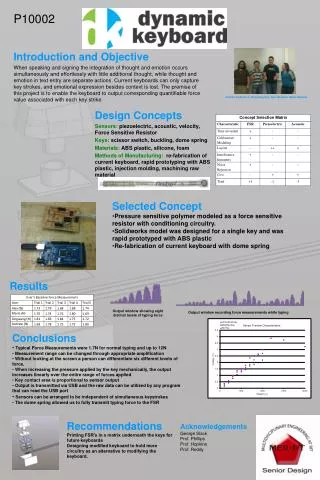

Enhancing Keyboard Interaction: Integrating Force Sensitivity for Emotional Expression
E N D
Presentation Transcript
P10002 Andrew Robertson, Xingwang Gao, Alex Moulton, Marie Hammer Introduction and Objective When speaking and signing the integration of thought and emotion occurs simultaneously and effortlessly with little additional thought, while thought and emotion in text entry are separate actions. Current keyboards can only capture key strokes, and emotional expression besides context is lost. The premise of this project is to enable the keyboard to output corresponding quantifiable force value associated with each key strike. Design Concepts Sensors: piezoelectric, acoustic, velocity, Force Sensitive Resistor Keys: scissor switch, buckling, dome spring Materials: ABS plastic, silicone, foam Methods of Manufacturing: re-fabrication of current keyboard, rapid prototyping with ABS plastic, injection molding, machining raw material • Selected Concept • Pressure sensitive polymer modeled as a force sensitive resistor with conditioning circuitry. • Solidworks model was designed for a single key and was rapid prototyped with ABS plastic • Re-fabrication of current keyboard with dome spring Results Output window showing eight distinct levels of typing force Output window recording force measurements while typing • Conclusions • Typical Force Measurements were 1.7N for normal typing and up to 12N • Measurement range can be changed through appropriate amplification • Without looking at the screen a person can differentiate six different levels of force. • When increasing the pressure applied by the key mechanically, the output increases linearly over the entire range of forces applied • Key contact area is proportional to sensor output • Output is transmitted via USB and the raw data can be utilized by any program that can read the USB port • Sensors can be arranged to be independent of simultaneous keystrokes • The dome spring allowed us to fully transmit typing force to the FSR Recommendations Printing FSR’s in a matrix underneath the keys for future keyboards Designing modified keyboard to hold more circuitry as an alternative to modifying the keyboard. Acknowledgements George Slack Prof. Phillips Prof. Hopkins Prof. Reddy