Understanding Apportionment and Reapportionment in U.S. Politics
This guide explains key definitions related to apportionment and reapportionment in the United States. It covers concepts like census, congressional seats, and the impact of gerrymandering on districting. The Supreme Court mandates that states ensure equal population distribution across districts. The Reapportionment Act of 1929 established a permanent method for allocating 435 congressional seats based on the census. A hands-on map activity reinforces these concepts by requiring students to divide a state's population into equal districts, emphasizing the importance of fair districting without manipulation.

Understanding Apportionment and Reapportionment in U.S. Politics
E N D
Presentation Transcript
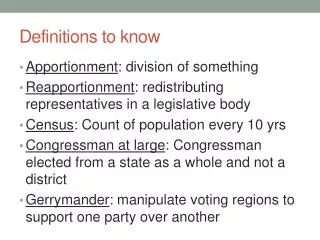
Definitions to know • Apportionment: division of something • Reapportionment: redistributing representatives in a legislative body • Census: Count of population every 10 yrs • Congressman at large: Congressman elected from a state as a whole and not a district • Gerrymander: manipulate voting regions to support one party over another
Wesberry v Sanders 1964 • Congressional seats in Georgia were not divided equally • Supreme Court requires each state to draw its districts so they are approximately equal in population • Reapportionment Act of 1929 • Permanent method for apportioning, 435 seats to census, systems of allocation
Instructions for Map Activity • 1. This state is entitled to 10 members in the US House of Representatives because its total population is 5 million. • 2. Divide the state into 10 districts in such a way to make each district as equal as possible and as geographically compact as possible (no gerrymandering). A district may be smaller than the county or include more than one county. The variance between each county should be no more than -/+ 10,000. • 3. Each district=500,000 -/+ • Color each district in a different color (10) Make sure to outline each. Number them. • Make a key-Color, # of the district and population total.