COUNTING ATOMS
Understanding how to count atoms in chemical compounds is essential for chemistry. This guide covers the basic rules: subscripts indicate the number of atoms directly behind them (e.g., in H2S, there are 2 Hydrogen and 1 Sulfur), while coefficients multiply everything in the compound (e.g., 2H2S means 4 Hydrogen and 2 Sulfur). Additionally, if there is no subscript, assume one atom. Parentheses modify everything inside: for instance, Ba(OH)2 signifies 1 Barium, 2 Oxygens, and 2 Hydrogens. Practice with examples like MgCl2 and H2SO4 to master counting.

COUNTING ATOMS
E N D
Presentation Transcript
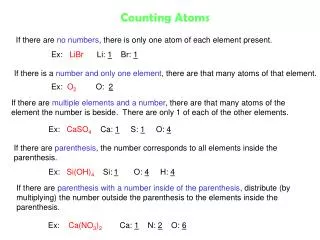
RULES FOR COUNTING ATOMS • SUBSCRIPTS only refer to the atom that they are BEHIND. For example… H2S There are TWO atoms of HYDROGEN and only ONE atom of SULFUR.
COEFFICIENTS • COEFFICIENTS apply to the entire compound. You MULTIPLY the coefficients and SUBSCRIPTS. 2H2S ATOMS OF HYDROGEN: ATOMS OF SULFUR: 4 2 IF THERE ISN’T A SUBSCRIPT BEHIND AN ELEMENT, ASSUME THERE IS ONLY ONE ATOM OF THAT ELEMENT!
PARENTHESES 3. If elements or compounds are inside of PARENTHESES, then the SUBSCRIPT behind the parentheses applies to everything inside. Ba(OH)2 ATOMS OF BARIUM: ATOMS OF OXYGEN: ATOMS OF HYDROGEN: 1 2 2
LET’S PRACTICE! MgCl2 Atoms of Magnesium: Atoms of Chlorine: 1 2 Al2S3 Atoms of Aluminum: Atoms of Sulfur: 2 3
PRACTICE H2SO4 Atoms of Hydrogen: Atoms of Sulfur: Atoms of Oxygen: 2 1 4 CH3OH Atoms of Carbon: Atoms of Hydrogen: Atoms of Oxygen: 1 4 1
THIS COULD BE A LITTLE TRICKY… Ca3(PO4)2 Atoms of Calcium: Atoms of Phosphorus: Atoms of Oxygen: 3 2 8 Al2(SO4)3 Atoms of Aluminum: Atoms of Sulfur: Atoms of Oxygen: 2 3 12
What about this BAD BOY??? 2Ca3(PO4)2 Atoms of Calcium: Atoms of Phosphorus: Atoms of Oxygen: 6 4 16