
Understanding Valve Characteristics: Inherent vs Installed Characteristics for Process Control
This guide explores valve characteristics crucial for process control in industrial applications. Author and professor Douglas Cooper explains the three common valve types: equal percentage, linear, and quick opening. It discusses how to select the right inherent valve characteristic to achieve a linear installed characteristic, which optimizes process gain and simplifies system tuning. The selection often relies on experience or manufacturer recommendations. Additionally, feedback block diagrams in control systems are laid out, highlighting the roles of transducers, controllers, and energy transfer in loop dynamics.

Understanding Valve Characteristics: Inherent vs Installed Characteristics for Process Control
E N D
Presentation Transcript
CBE / MET 433 22 Feb 12 (Transfer functions and Block Diagrams) Professor Douglas Cooper, author Loop Pro-Trainer
What are Valve CharacteristicsInherent Characteristics • The three most common valve characterizations are equal percentage, linear, and quick opening Professor Douglas Cooper, author Loop Pro-Trainer
What are Valve CharacteristicsInstalled Characteristics • In many process applications the pressure drop across a valve varies with the flow. In these instances an equal percentage valve will act to linearize the process. Equal percentage valves are the most commonly used control valves. • How do you know what inherent valve characteristic to choose to get a linear installed characteristic? • The correct selection of valve characteristic to linearize the process gain will ease the tuning process and make for a robust system. • Most times this selection is through experience, guesswork or the valve manufacturer’s recommendation. Professor Douglas Cooper, author Loop Pro-Trainer
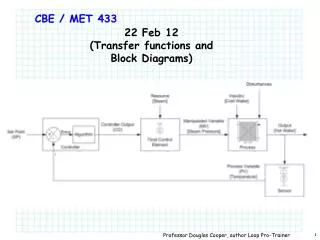
Feedback Block Diagram Transmitter Transducer Valve Energy Transfer Controller Process
Feedback Block Diagram + + + -
Open Loop vs Closed Loop Transfer Function (R(s)=0) Open Loop: + + + - Closed Loop:
Transfer Functions (Chap 3-5) Define: For heated, stirred tank: + + + + + + - -