Understanding Molecules and Compounds: Definitions and Examples
This concise guide elaborates on molecules and compounds, highlighting their definitions and differences. A molecule forms when two or more atoms combine chemically, while a compound specifically refers to a molecule consisting of different atoms. For instance, water is a quintessential compound. The properties of compounds can vary greatly from those of their constituent atoms, making it crucial to analyze them chemically. This overview is ideal for anyone seeking to grasp the foundational concepts of chemistry regarding molecular structures.


Understanding Molecules and Compounds: Definitions and Examples
E N D
Presentation Transcript
Molecules and Compounds By: Dustin, Jeremy, Tyler
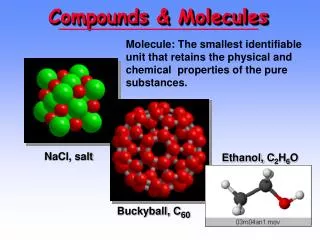
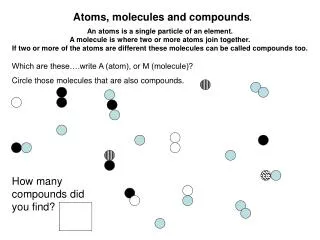
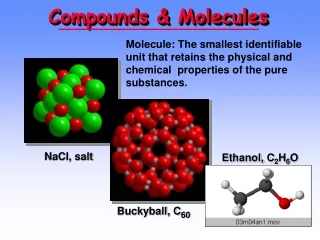
Definition • Molecules: When two or more atoms combine chemically • Compounds: When two or more different atoms combine to form a molecule, the molecule is more specifically called a molecule of a compound
Examples Compound A Molecule
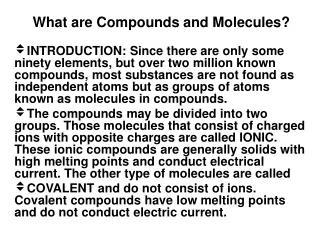
Molecules • If two or more atoms of the same element bond together, a molecule of that element is produced. When two or more different atoms bind together to form a molecule, the molecule is more specifically referred to as a molecule of a compound.
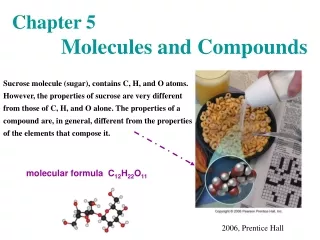
Compounds • Water is a good example of a compound • Compounds can have different properties then the atoms making them up • So it would be impossible to determine the atoms making up the compound without looking at it chemically
Works Cited • Marieb, Elaine, Molecules and Compounds, Essentials of Human Anatomy & Physiology, SerinaBeauparltant.Eight. San Fransisco: Daryl Fox, 2006, 32-33. Print.