
Water Extracts of P. vulgaris Effectively Inhibit Lentiviral Infectivity with Minimal Cell Toxicity
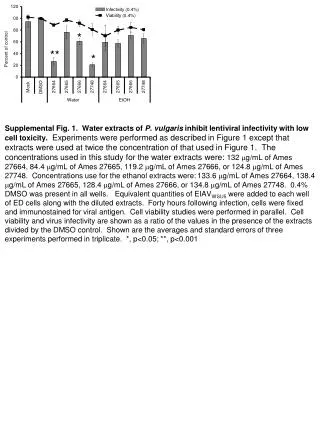
This study investigates the antiviral properties of water extracts from P. vulgaris on lentiviral infectivity. Extracts were tested at double the concentrations used in previous experiments, specifically 132 μg/mL of Ames 27664, 84.4 μg/mL of Ames 27665, 119.2 μg/mL of Ames 27666, and 124.8 μg/mL of Ames 27748. Simultaneously, ethanol extracts were utilized at specific concentrations. The results indicate significant reductions in viral infectivity while maintaining low cell toxicity, verified through cell viability assays and viral antigen immunostaining. Statistical significance was marked at p < 0.05 and p < 0.001.

Water Extracts of P. vulgaris Effectively Inhibit Lentiviral Infectivity with Minimal Cell Toxicity
E N D
Presentation Transcript
* ** * Supplemental Fig. 1. Water extracts of P. vulgaris inhibit lentiviral infectivity with low cell toxicity. Experiments were performed as described in Figure 1 except that extracts were used at twice the concentration of that used in Figure 1. The concentrations used in this study for the water extracts were: 132 g/mL of Ames 27664, 84.4 g/mL of Ames 27665, 119.2 g/mL of Ames 27666, or 124.8 g/mL of Ames 27748. Concentrations use for the ethanol extracts were: 133.6 g/mL of Ames 27664, 138.4 g/mL of Ames 27665, 128.4 g/mL of Ames 27666, or 134.8 g/mL of Ames 27748. 0.4% DMSO was present in all wells. Equivalent quantities of EIAVWSU5 were added to each well of ED cells along with the diluted extracts. Forty hours following infection, cells were fixed and immunostained for viral antigen. Cell viability studies were performed in parallel. Cell viability and virus infectivity are shown as a ratio of the values in the presence of the extracts divided by the DMSO control. Shown are the averages and standard errors of three experiments performed in triplicate. *, p<0.05; **, p<0.001