Download
1 / 11
110 likes | 215 Vues
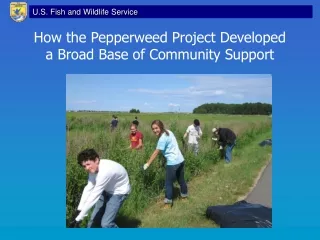
The Pepperweed Project emerged as a collaborative effort to manage Perennial Pepperweed (Lepidium latifolium) across the U.S. and Canada. Starting in the 1990s at Parker River NWR, the initiative involved diverse community engagement, including youth groups and local environmental reporters. Efforts included herbicide testing, control projects, and extensive mapping in the Great Marsh region. By 2010, hundreds of volunteers contributed to ongoing management across six towns, demonstrating the importance of community support in combating invasive species.

E N D
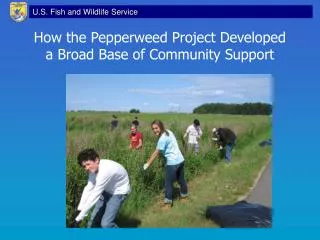
How the Pepperweed Project Developed a Broad Base of Community Support
Distribution of Perennial Pepperweed in the United States and Canada (from USDA’s Plants Database)
Perennial Pepperweed, Lepidium latifolium 6-petaled white flowers Alternate leaves Horseradish scent to leaves, stem and roots
Pepperweed plants Pepperweed flowers
History of the project 1990’s: Pepperweed identified on Parker River NWR 2002: Mass Audubon’s Salt Marsh Science Project to pull Pepperweed on Refuge 2004: Refuge tests herbicides and concentrations on Pepperweed 2005: Newburyport GOMI team takes on Pepperweed control as team project 2006: Refuge begins project to control Pepperweed on and adjacent to Refuge Mapping begins in Great Marsh region 2007: MA-NH-ME forms to collaborate and communicate about invasive spread in coastal corridor. Pepperweed project expands to Great Marsh 2008-2010: On going Pepperweed control in 6 towns, hundreds of volunteer hours, continued community support.
Keys which may help other project • Youth support—youth groups, after school programs, high school science classes, community service requirements • Find local environmental reporters who will write about your projects.