Advancements in Integral Field Spectroscopy for Astrophysical Observations
This document outlines cutting-edge developments in Integral Field Spectroscopy (IFS) at the University of Wisconsin-Madison. It highlights ambitious goals for deploying systems across various telescope apertures and utilizing multi-IFU configurations coupled with spectrographs. Key areas of focus include large field-of-view systems, engagement with community-based scientific opportunities, and improved data handling with common software architectures. The future of IFS promises high-resolution observations and rich data sets that revolutionize astrophysical understanding.

Advancements in Integral Field Spectroscopy for Astrophysical Observations
E N D
Presentation Transcript
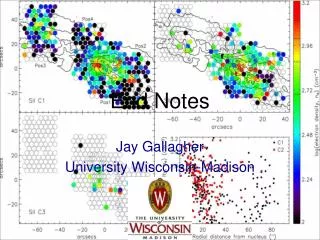
End Notes Jay Gallagher University Wisconsin-Madison
Hardware: IFS systems deployed on range of telescope apertures: • Field of view—large arrays/distributed/deployable IFUs—multi-IFU+spectrograph future • High “grasp” systems • IFUs + AO! • Guide stars—rethink “best” target • Scanning systems; FP, FT • Space—the final frontier (maybe?)—Herschel, • Large data sets! Data rich spectroscopy!
Build & science follows: • range of applications—across wavelength, distance, & intrinsic spatial scales • paradigm shift in the making—astrophysical systems seen in 2-D projection—use full information content in images • community engagement growing, but sometimes a bit slowly highlight scientific opportunities!
Software—common grounds? • multiple instruments many approaches to dealing with data • pipelines for the basics • uniform format data cubes • open architectures • sites for software exchanges • data analysis tools • comm tools: publication of results • movies now (contours-nice!) • future?
When is the future coming now, soon…??? • ELTs equipped with IFUs for IFS • don’t ignore FT capabilities –natural seeing • high contrast AO vs high grasp + resolution (higres?) systems • More is better—high Ω survey modes • JWST-low background/wavelength agility • future complimentarity • optical/UV?
Stay in touch: WIKI Post workshop email follow-up
Thanks to: Tracy Beck Katrina Exter Linda Smith Mark Westmoquette STScI Support Staff