Understanding Sheep's Behavioral & Reproductive Differences
70 likes | 186 Vues
Explore the significance of sex-based variances in early, juvenile, and adult social behaviors in sheep. Learn about masculinization and defeminization through experimental models emphasizing hormonal influence during critical periods. Discover physiological consequences and growth patterns linked to testosterone exposure.


Understanding Sheep's Behavioral & Reproductive Differences
E N D
Presentation Transcript
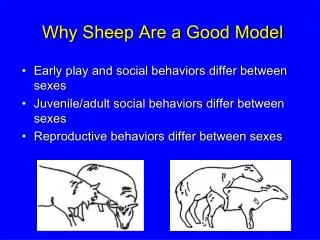
Why Sheep Are a Good Model • Early play and social behaviors differ between sexes • Juvenile/adult social behaviors differ between sexes • Reproductive behaviors differ between sexes
Sheep Critical Period Postnatal 1. timing of pubertal increase in GnRH secretion function of GnRH surge system MASCULINIZATION DEFEMINIZATION conception birth STEROIDS ORGANIZE FEEDBACK CONTROL OF GnRH SECRETION 0 30 60 90 120 150 days of pregnancy
Treatment • Pregnant females injected with testosterone or oil vehicle during 2nd trimester from 30-90 days of gestation • Groups: • 30-90 days of oil [CM and CF] • 30-90 days of TP (100 mg 2x/week) [TM and TF] • 60-90 days of TP (100 mg 2x/week) [F only]
Physiological Consequences • TP at both durations causes fetal growth retardation in both sexes (weight, height and chest circumference) Mannikam, et al, Endocrinology, 2004 • TP for 30-90, but not 60-90 days, alters external genitalia in both sexes • TP at both durations causes male urination pattern in females
External Genitalia Mannikam, et al, Endocrinology, 2004