Download
1 / 2
20 likes | 134 Vues
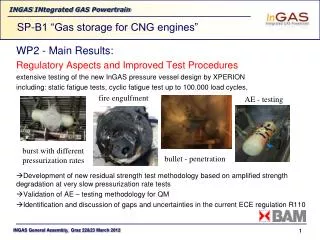
This document outlines the extensive testing and regulatory evaluation of a new pressure vessel design by XPERION for CNG engines. It highlights innovative testing methodologies, including static and cyclic fatigue tests up to 100,000 load cycles, and the development of a new residual strength test methodology. The study also examines gaps in current ECE regulations regarding fire engulfment and burst testing. Findings will support advancements in hydrogen storage and composite containment for vehicle applications.

E N D
SP-B1 “Gas storage for CNG engines” WP2 - Main Results: Regulatory Aspects and Improved Test Procedures extensive testing of the new InGAS pressure vessel design by XPERION including: static fatigue tests, cyclic fatigue test up to 100.000 load cycles, • Development of new residual strength test methodology based on amplified strength degradation at very slow pressurization rate tests • Validation of AE – testing methodology for QM Identification and discussion of gaps and uncertainties in the current ECE regulation R110 fire engulfment AE - testing burst with different pressurization rates bullet - penetration
SP-B1 “Gas storage for CNG engines” Dissemination of Foreground Testing Methodology: Research on RC&S for Hydrogen Storage Relevant to transport and Vehicle issues with special focus on Composite Containments, P. Pöschko, G. Mair International Conference on Hydrogen Safety, 9/12/2011 AE – Methodologyfor QM: Überwachung der Fertigungsqualität von Faserverbund-Druckbehältern mittels Schallemissionsprüfung, E. Duffner, J. Bohse, C. Gregor Kolloquium Schallemission der DGZfP in Wetzlar vom 27. - 28. Oktober 2011