Understanding Isotopes: Discover What Defines Them in Elements
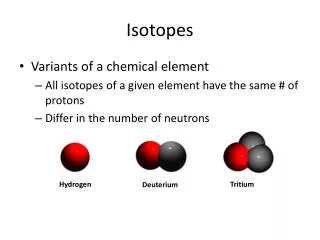
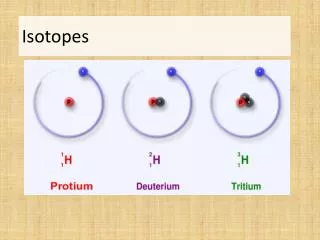
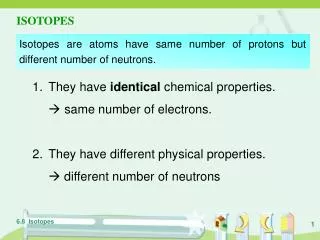
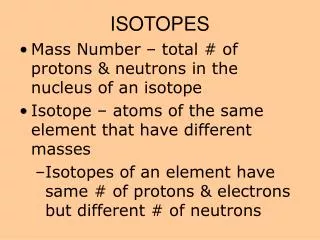
Isotopes are variants of a chemical element that differ in neutron count while retaining the same number of protons and electrons. This results in different mass numbers. For example, oxygen typically has 8 protons and 8 neutrons, giving it a mass number of 16. Variants like oxygen-17 and oxygen-18 have 9 and 10 neutrons, respectively. This diversity in neutron number influences the properties and applications of elements in various fields, from chemistry to medicine.


Understanding Isotopes: Discover What Defines Them in Elements
E N D
Presentation Transcript
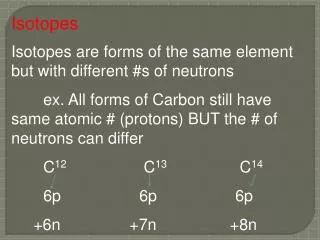
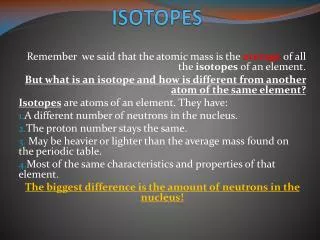
What is an isotope? • Every atom in an element has the SAME number of protons and electrons. • NOT ALL atoms in an element have the same neutrons. • AN ISOTOPE is an element that has a different number of neutrons and mass number
Example • Oxygen has 8 protons. 8 neutrons • Mass # = 16 • Some oxygen atoms have 8 protons, 9 neutrons • 8 + 9 = 17 (mass #) • Some have 8 protons and 10 neutrons • Called Oxygen-16, oxygen-17, oxygen-18