Innovative Touch-Free Remote Control for TV Using Hand Motion Sensing
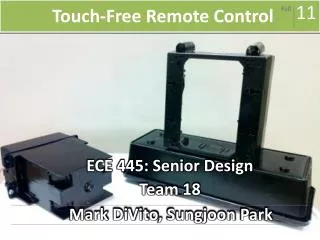
Our project presents a user-friendly, touch-free remote control designed to operate your TV with simple hand gestures. This innovative device eliminates the need for buttons, allowing users to change channels, adjust volume, and control power with ease. Utilizing advanced RF transmission technology, the remote works without line-of-sight and is responsive even with greasy hands. With a lightweight, portable design and precise hand motion detection, this system offers a new way to interact with TVs, ensuring convenience and reliability.

Innovative Touch-Free Remote Control for TV Using Hand Motion Sensing
E N D
Presentation Transcript
11 Fall Touch-Free Remote Control ECE 445: Senior Design c Team 18 Mark DiVito, Sungjoon Park
Objective • Design and build a user-friendly touch-free remote control • Device will sense user hand movements and control various parameters on a TV • Ability to change the channel, volume, and turn the TV on and off • No buttons!
Features • Light-weight and portable battery-powered transmitter • Change channels, volume, power • Precise hand motion detection and interpretation
Benefits • No need to use complex remote buttons • Does not need line-of-sight to TV because of RF transmission • Can use the remote with greasy potato chip hands • A new and unique way of TV interaction
Original Design Transmitter
Original Design Transmitter
Original Design Receiver
Original Design Receiver
Voltage Regulator 120Ω Vout= Vref(1+R2/R1) +IadjR2 Vin = 4 x 1.5 = 6 V 3.03 V nominal output 166Ω
Phototransistor Amplifier • No hand: phototransistor conducts, Vout = VOL • Hand: no current, no voltage drop across R2, Vout = VOH 20kΩ 6.2kΩ Vout 220kΩ
Phototransistor Amplifier • Phototransistor current spec range 100nA to .5mA • Physical design: • VOL = .22V • VOH = 3V • Can interpret as logical 0 and 1 • Detects light 1ft away 3V 0.1V 200uA 0uA
Input Translation • MSP430: receives analog input from sensors • Hand detection based on threshold voltage • State machine with timing requirements • Serial data output to RF transmitter
Input Translation Tests and calibration: • Detection distance from proximity sensor • Appropriate speed for hand motions • How fast are repeated commands sent
RF Transmitter and Receiver • 434 MHz carrier frequency • Spec is 10,000 bps
RF Transmitter and Receiver • Test: max transmitter driving frequency where received data is valid is ~40kHz • Range: 10ft with no antenna, ~100ft with whip style external antenna • 20kHz square wave driving transmitter • 2V/div • 50us/div • ~25us delay
RF to IR Translator • Arduino Uno: receives RF serial input from receiver • Decodes the serial input and determines desired command • Drives IR LED to send command to TV
RF to IR Translator • Test: IR LED output within 5% of RC5 protocol timing spec • Spec is 889us length for one bit, measured 890us length, 0.11% difference • dx = 890 us • 2V/div • 500us/div
System Performance • The remote’s sensors should respond to a hand approximately 1 to 2 inches away • The time from a user input to the IR transmitter sending a signal to the TV should be less than 200ms • No information loss • dx = 186 ms • 2V/div • 50ms/div
Challenges • Constructing the case • PCB • Sensor alignment and placement in the case • Four AA batteries instead of two • Determining what type of sensors to use
Conclusions • The final product worked as intended and provides the user with a reliable touch-free remote experience • The system meets all timing and reliability performance requirements • Each block was successfully tested individually as well as the system as a whole
Recommendations • Add more phototransistor sensors • More sensors would add the ability to support more gestures and commands • Better methods to keep sensors aligned in the case • Higher quality reflective proximity sensors