Download
1 / 6
60 likes | 170 Vues
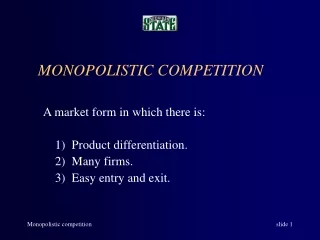
Monopolistic competition is characterized by a market structure where many small firms operate independently, offering differentiated products. Unlike perfect competition, these firms have some control over prices but face relatively elastic demand curves. The ease of entering or exiting the market encourages new firms to join when economic profit is present. In the long run, increased competition erodes excess profits, leading firms to earn normal profits. Monopolistic competition results in excess capacity, where resources are not fully utilized, creating a gap between production levels and cost efficiency.

E N D
Characteristics • Small firms (size) • Fewer numbers than in PC • No collusion (cooperation) between firms • Independent actions • Differentiated Product • Some control over price • Easy to enter or exit the market • Advertising • Emphasize non-price differences (product differences)
Demand Curve • Highly (but not perfectly) elastic • More elastic than monopoly but less elastic than perfect competition • Less competition • Products are not perfect substitutes P D (Monopoly) D (perfect competition) D (monopolistic competition) Q
Short Run Profit Maximization • Economic profit is achieved if P>ATC minimum P MC Profit max P is set here ATC PMC Profit ATCmin Profit max Q is set here D QMC Q MR
Long Run Adjustment • If economic profit is earned, new firms will enter the industry • More competition so some consumers will go to other sellers • Demand curve shifts left, lowers price and wipes out economic profit • In LR firms will only earn normal profit
MC firms are not productive or allocatively efficient • Excess Capacity • Don’t produce at efficient amount • Some resources left underused • Gap between Q of MC=MR and Q of ATCmin is the lost capacity