Understanding One-Dimensional Arrays: Structure, Access, and Initialization
One-dimensional arrays are structured collections of components accessed individually by a single index. Also known as arrays of elements, they are defined in C++ with syntax such as DataType ArrayName[ConstIntExpression]. Accessing individual components is done via ArrayName[IndexExpression]. Caution is required with out-of-bounds indexes, as accessing memory beyond allocated limits may result in segmentation faults. Arrays can be initialized at declaration (e.g., int a[5] = {23, 10, 16, 37, 12};) and the size can be omitted if initialized simultaneously. However, they lack support for aggregated operations.


Understanding One-Dimensional Arrays: Structure, Access, and Initialization
E N D
Presentation Transcript
Arrays Robert Reaves
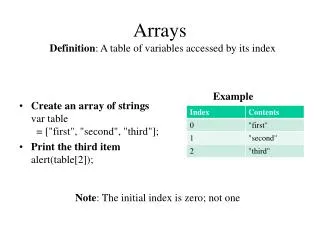
One-Dimensional Array • One-Dimensional Array is a structured collection of components that can be accessed individually by specifying the position of a component with a single index value. • Also called an array of elements. • Declaration: • DataTypeArrayName [ ConstIntExpression ];
Accessing Individual Components of an Array • Array Component Access: • ArrayName [ IndexExpresson ]
Out-of-Bounds Array Indexes • Given: • float alpha[100]; • What happens if we execute this statement when i = 0 or i > 99? • alpha[i] = 62.4; • We get a Segmentation Fault. • Meaning you are accessing memory that is allocated.
Initializing Arrays in Declarations • int a[5] = {23, 10, 16, 37, 12}; • Where: • a[0] will = 23 • a[1] will = 10 • a[2] will = 16 • a[3] will = 37 • a[4] will = 12 • Can also omit the size of the array if you use this type of declaration and initialization. (With C++) • int a[] = {23, 10, 16, 37, 12};
(Lack of) Aggregated Operations • I/O -> No • Assignment -> No • Comparison -> No • Argument Passage -> By reference • Return as a function’s return value -> No