
Synthesis and Photochemical Characterization of Hexacoordinate Silicon(diimine)3 Complexes

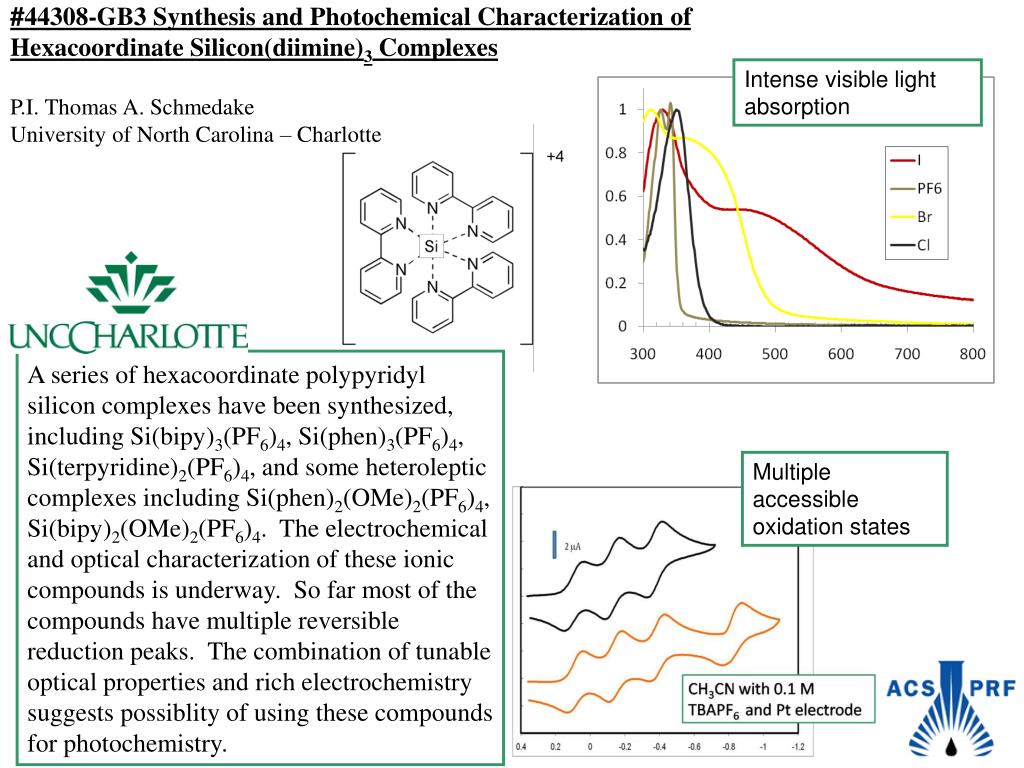
This study explores the synthesis of hexacoordinate polypyridyl silicon complexes, namely Si(bipy)3(PF6)4, Si(phen)3(PF6)4, and Si(terpyridine)2(PF6)4, alongside heteroleptic counterparts. The compounds exhibit intense visible light absorption, with electrochemical and optical characterization currently underway. Preliminary results indicate multiple reversible reduction peaks, highlighting their rich electrochemistry. The tunable optical properties and diverse oxidation states suggest promising applications in photochemistry, opening avenues for further research in this area.
Télécharger la présentation 
Politique de téléchargement : le contenu du site vous est fourni TEL QUEL pour votre information et votre usage personnel ; il ne peut être vendu, concédé sous licence ni partagé sur d’autres sites sans l’accord de son auteur.Le contenu vous est fourni TEL QUEL, pour votre information et votre usage personnel uniquement. Téléchargez la présentation en cliquant sur ce lien. Lors du téléchargement, si vous ne parvenez pas à télécharger une présentation, l’éditeur a peut-être supprimé le fichier de son serveur.Pendant le téléchargement, si vous ne parvenez pas à obtenir une présentation, le fichier a peut-être été supprimé par l’éditeur.
F I N