Download
1 / 9
90 likes | 187 Vues
Explore the process from DNA to protein, including transcription and translation, different types of RNA, DNA compared to RNA, RNA modification, and the genetic code. Learn how genes are decoded into amino acids in cells.

E N D
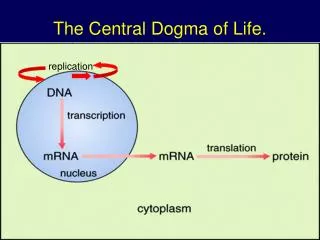
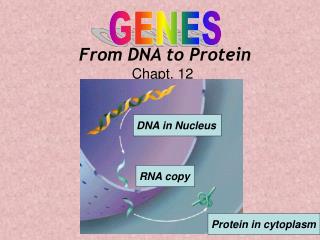
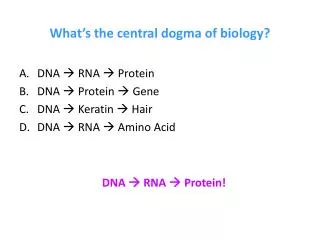
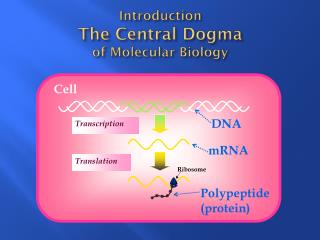
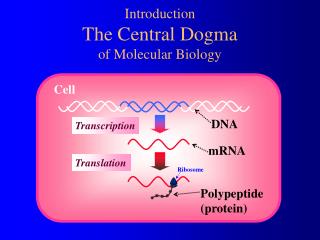
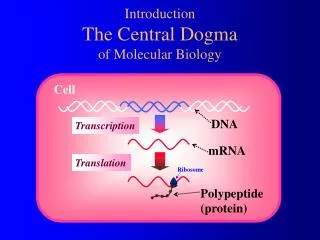
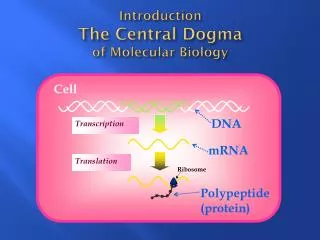
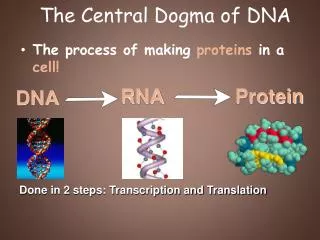
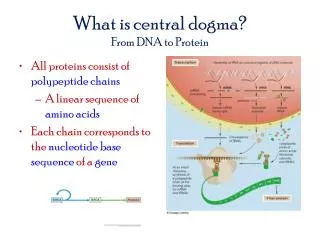
What is central dogma?From DNA to Protein • All proteins consist of polypeptide chains • A linear sequence of amino acids • Each chain corresponds to the nucleotide base sequence of a gene
What is the first step? 1. Transcription: Enzymes uses base sequence of a gene as template to make strand of RNA • Two DNA strands unwind in a specific region • RNA polymerase assembles strand of RNA • Covalently bonds RNA nucleotides (adenine, guanine, cytosine, uracil) according to nucleotide sequence of exposed gene
What is the second step? • 2. Translation • Information in the RNA strand is decoded (translated) into a sequence of amino acids
Prokaryotes and eukaryotes • In prokaryotic cells (no nucleus) • Transcription and translation occur in cytoplasm • In eukaryotic cells • Genes are transcribed in the nucleus • Resulting mRNA is translated in the cytoplasm
Three types of RNA • Messenger RNA (mRNA) • Carries protein-building codes from DNA to ribosomes • Ribosomal RNA (rRNA) • Forms ribosomes (where polypeptide chains are assembled) • Transfer RNA (tRNA) • Delivers amino acids to ribosomes
RNA and DNA compared • DNA • exists as double-stranded molecules • hereditary information • double helix • contains deoxoyribose sugar • RNA • Disposable copies of hereditary information and some are catalytic • exists as a single stand. • contains ribose instead of deoxyribose • contains uracil in place of thymine
RNA Modification: Alternative Splicing • Before mRNA leaves the nucleus: • Introns are removed • Some exons are removed along with introns; remaining exons are spliced together in different combinations • Poly-A tail is added to 3’ end of new mRNA
What is the genetic code? • Messenger RNA (mRNA) carries DNA’s protein-building information to ribosomes for translation • mRNA’s genetic message is written in codons • Sets of three nucleotides along mRNA strand
Codons • Codonsspecify different amino acids • A few codon signals stop translation • Sixty-four codons constitute a highly conserved genetic code