Download
1 / 13
130 likes | 284 Vues
This workshop presentation by Peter Kalmus from Caltech discusses strategies for analyzing data from gravitational wave (GW) searches related to supernovae (SNe), particularly core-collapse supernovae (CCSNe). Key motivations include optimizing searches for theoretical predictions and addressing unknowns in data analysis. The talk covers topics such as allowed GW waveforms, signal region handling, glitch suppression techniques, and the development of effective pipelines. Future goals encompass improving detection strategies and preparing for new observational opportunities as detector technology advances.

E N D
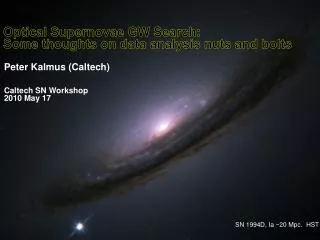
Optical Supernovae GW Search: Some thoughts on data analysis nuts and bolts Peter Kalmus (Caltech) Caltech SN Workshop 2010 May 17 SN 1994D, Ia ~20 Mpc. HST
A Search for CCSNe in the Nearby Universe • Optically-triggered search for GW from CCSNe <~25 Mpc • Detection statement and first SN model upper limits • Motivation: • Attempt to constrain extreme SN models • Prepare for Betelgeuse • Prepare for aLIGO • Prepare for a neutrino+optical triggered search • Optimize search for theoretical predictions… • frequency, duration, and modeled waveforms • … but remembering the unknown unknowns
My workshop goals • Come away with a plan • Identify challenges • Deal out initial tasks • ExtTrig telecon • What models do we expect to limit in S5/S6? aLIGO? ET? • Decide which GW waveforms to include in the search • Begin to think about future searches
Mostly I have DA questions, not DA answers • What target GW waveforms should we use? (connects theory and DA) • How do our upper limits depend on signal region size? • How to handle GW data gaps in the signal region? • How to handle changing detector networks over the signal region? • How to handle data quality effectively? • Can we devise an effective sky location veto to improve sensitivity? • Can glitch suppression be effectively folded into the detection statistic? • Optimize clustering on the time-frequency plane • Can we modify and use an existing pipeline? • How much better can we do than the all-sky all-time search? • Will models be constrained by closest SN(e), or can we fold them together?
Do we agree on the following DA approach? • Excess power type externally triggered “burst” search • 1… N detectors Time-frequency tilings clustering • e.g. X-Pipeline, Flare, Coherent Waveburst, Omega • Choose appropriate signal region and background region • Search for significant analysis events in signal region • use background region to estimate false alarm rate • Set model-dependent loudest event upper limits • use target waveform simulations injected into detector noise
Rejecting glitches • Larger signal region larger probability of getting a big glitch • Big glitches make for worse upper limits • Data quality will be critical, as in the all-sky all-time searches • Also, the DA pipeline must work hard to reject glitches • old technology: null stream, amplitude consistency (H2 helps) • sky location veto • measure glitchiness at each frequency; include in detection statistic
A changing GW detector network • GW detectors coming up and down • Antenna factors change with Earth’s rotation • This is new for exttrig searches, old for all-time searches • How to present upper limit results? Gregg Harry 2007
Excess power + clustering • Several of the SNGW waveforms have gaps • 2D clustering with “gap jumping” capabilities Murphy, Ott, & Burrows 2009 GW emission from convection/SASI/turbulence
Multiple triggers, one upper limit? • Several SNe, at different distances • Signal regions will have missing data • Can we make a compelling combined statement? • Could it improve constraints?
Need to pick signal regions! Caltech summer undergrad
Short term goals • Find out who wants to do what; momentum in ExtTrig telecons • Get some initial target SNGW waveforms to put into noise • Create pipeline prototypes & begin quantifying with waveforms: • play with glitch-rejecting detection statistics • play with sky location veto • optimize clustering for target GW waveforms • Determine SNe set for S5/S6; signal regions • Katherine Kauffman SURF 2010 (mentors: Christian Ott, PK)
Medium term goals • Settle on a SN search strategy • Methods paper(s) addressing new problems • Should allow for a short results paper
Future searches: 2nd, 3rd generation detectors • Improved optical observations tighter signal regions? • Adding neutrinos to the mix • Planning for a detection • Collaborations • Extracting science • Limiting additional models with better detectors hst