Model-View-Controller Architecture in a Systems Analysis and Design Course
290 likes | 413 Vues
This course, taught by Dr. Robert F. Zant at Illinois State University, provides an in-depth exploration of the Model-View-Controller (MVC) architecture within the realm of systems analysis and design. It covers essential MVC concepts, demonstrating real-world applications through simulated projects and hands-on learning. The curriculum spans both traditional and object-oriented systems development, emphasizing practical skills for novice system developers. Students engage with a unified MVC framework applicable across various technology contexts, aligning with industry standards.


Model-View-Controller Architecture in a Systems Analysis and Design Course
E N D
Presentation Transcript
Model-View-Controller Architecture in a Systems Analysis and Design Course Dr. Robert F. Zant Illinois State University
The Plan • Curriculum overview • MVC Concepts • Example MVC implementation
Systems Development I • Taken by all IS majors • Covers Traditional and Object-Oriented SAD
Systems Development II • Taken by IS majors in Systems Development/Analyst Sequence • Covers Traditional SAD • Includes Simulated Project
OO Systems Development • Taken by IS majors in Web Application Development Sequence • Covers Object Oriented SAD • Includes Simulated Project
Directed Project in Information Technology • Taken by IS majors in both sequences • Includes Real-World Project
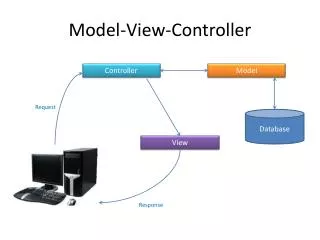
MVC Architecture • Used in both second level courses as a unifying theme • Provides an architectural template for novice system developers • Use is prevalent in industry
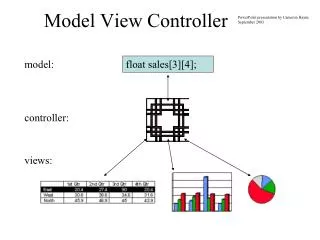
MVC • Controller - Interprets user requests and invokes Model and View • Model - contains application logic and access logic for persistent data • View - displays model results to user
Guidelines • All responses from users are processed first by a Front Controller • Communication of user responses to the Front Controller is by name (e.g., field names on HTML forms) • A Front Controller invokes a Page Controller, not a Model or View • A Page Controller invokes one Model and one View
Guidelines (cont.) • A Model executes application logic and accesses data stores (contains no HTML) • A Model creates an XML file or an object containing its results • Communication of Model results to a View are by name (e.g., tags in XML)
Guidelines (cont.) • A View creates a presentation stream • A View contains no application logic • A View obtains all non-constant text data from the XML file or result object produced by the Model • A View does not directly reference any data in a Model or URL for the site
Example Front Controller <% NOTE: This is the Front Controller ; DEFAULT pc = "menu", sys_base = $path_Translated_dir$"/", url_base = http:"//"$server_name$$path_info_dir$"/", home = $url_base$index.odb ; SESSION LOGIN = "login.odb?from=$pc$", TIMEOUT = 10 ; INCLUDE $sys_base$"c/"$pc$".c"; %>
Example Page Controller <% NOTE: Page Controller to List Products ; INCLUDE $sys_base$m/Products/table1.m ; INCLUDE $sys_base$v/Products/table1.v ; %>
Example Model <% NOTE: Model to List Products ; DATABASE "DSN=myProducts" ; SELECT Category, ProductID, Heading, Description, UnitPrice, UnitsOnHand FROM Products ORDER BY ProductID ; OUTPUT $xmlfile$ ; NOTE: xmlfile defined during login; %> <?xml version="1.0" ?> <?xml-stylesheet type="text/xsl” href="$xslt$”?> <root> <links> <home>$home$</home> </links>
Example Model (cont.) <products> <% EACHROW %> <row> <ProductID>$ProductID$</ProductID> <Category>$Category$</Category> <Description>$Description$</Description> <UnitPrice>$UnitPrice$</UnitPrice> <UnitsOnHand>$UnitsOnHand$</UnitsOnHand> </row> <% ENDROW %> </products> </root> <% OUTPUT %>
Example XML File <?xml version="1.0"?> <?xml-stylesheet type="text/xsl" href="$xslt$" ?> <root> <links> <home>http://localhost/new/widgets/index.odb</home> </links> <products> <row> <ProductID>3</ProductID> <Heading>Reinforced plastic 8 inch</Heading> <Category>Plastic Widgets</Category> <Description>Oversized polyethelene with steel</Description> <UnitPrice>10.0000</UnitPrice> <UnitsOnHand>70</UnitsOnHand> </row> </products> </root>
Example View SET xslt = $url_base$"v/Products/xslt/table1.xslt" ; INCLUDE $xmlfile$ ;
Example XSL <?xml version="1.0"?> <xsl:stylesheet version="1.0" xmlns:xsl="http://www.w3.org/1999/XSL/Transform"> <xsl:output method="html" omit-xml-declaration="yes"/> <xsl:template match="/"> <html xmlns="http://www.w3.org/1999/xhtml" lang="en" xml:lang="en"> <head> <meta http-equiv="content-type" content="text/html" /> <title>World Wide Widgets</title> <style type="text/css"> @import url(v/widgets.css);</style> </head> <body>
Example XSL (cont.) <div id="pageHeader"> <a><xsl:attribute name="href"> <xsl:value-of select=“root/links/home"/> </xsl:attribute><h1>World Wide Widgets</h1></a> </div> <!-- End of Page Header --> <xsl:apply-templates /> <div id="pageFooter"> [<a><xsl:attribute name="href"> <xsl:value-of select=“root/links/home"/> </xsl:attribute>Continue...</a>] </div> <!-- End of Page Footer --> </body> </html> </xsl:template>
Example XSL (cont.) <xsl:template match=“products"> <table> <caption>Products<br />by Product ID</caption> <tr> <th>Product ID</th><th>Product</th> <th>Category</th><th>Description</th> <th>Price</th><th>On Hand</th> </tr> <xsl:apply-templates select=“row"/> </table> </xsl:template>
Example XSL (cont.) <xsl:template match=“row"> <tr> <td><xsl:value-of select=“ProductID" /></td> <td><xsl:value-of select="Heading" /></td> <td><xsl:value-of select="Category" /></td> <td><xsl:value-of select="Description" /></td> <td><xsl:value-of select="format-number (UnitPrice,'$###,##0.00')" /></td> <td><xsl:value-of select="UnitsOnHand" /></td> </tr> </xsl:template> </xsl:stylesheet>
Recommended Software • ODB Script • http://odbscript.com/ • Abyss Web Server • http://www.aprelium.com/ • Cooktop • http://xmlcooktop.com/ • TextPad • http://www.textpad.com/
Thank You Questions?