Year-round High Tunnel Production
330 likes | 458 Vues
This presentation by Steve Moore from NCSU outlines the advantages of year-round high tunnel production techniques. It discusses historic uses of season extension, including maintaining vital sales, enhancing cash flow, and providing diverse, fresh produce while reducing energy demands. The presentation explores key factors like greenhouse design, passive solar options, and effective management practices for winter vegetables such as lettuce, greens, and herbs. It aims to inform farmers on maximizing yield and efficiency, ultimately contributing to a more sustainable and regional food system.


Year-round High Tunnel Production
E N D
Presentation Transcript
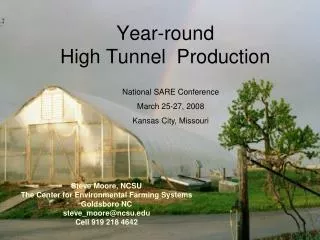
Year-round High Tunnel Production Steve Moore, NCSU The Center for Environmental Farming Systems Goldsboro NC steve_moore@ncsu.edu Cell 919 218 4642 National SARE Conference March 25-27, 2008 Kansas City, Missouri
Reasons for Season Extension • Maintain important sales outlets and customers • Spread out cash flow • Spread labor more evenly over the year • Sell products at higher (out of season) prices • Provide customers with greater diversity of products • Fresher and more nutritious produce • Produce higher gross sales and higher income per unit of area • Moderate climate change irregularities • Contribute to a more sustaining food system by lowering energy demands. distance food travels, creating a more regional food system
Heat Sources • Solar energy (light and heat) • Insolation, regional and site • Greenhouse orientation • Ambient heat of the earth • Thermal decay of a highly organic soil
Effects of Structure Design onThermal Performance • Gothic arch shape • Relationship of perimeter to surface area • Perimeter ground insolation • Use of interior covers • Types of films and coverings • Interior layouts • Gable end layout and ventilation
2003-2004 Thermal Performance of inner and outer covers in unheated Greenhouses standardized to outside for average temperatures mid December-mid February and for the average of five cold nights
Effects of various inner covers on Poc Choi (6mil plastic, typar, no cover)
Winter Vegetables • Lettuce (head and mixes) • Asian and other greens • Spinach • Parsley • Spring onions • Kale • Collards • Poc choi • Radish • Turnips • Chard • Celery • Herbs
Management Considerations • Soil salinization • IPM • Nitrate uptake in winter greens • Variety selection and development • Maximize yield within the structure
Effects of Salinity in Greenhouse Pepper Production (2003)High: 3.89 dS/m, Medium: 2.51 dS/m, Low: 0.85 dS/m
Maximizing Production • Use well started transplants in open flats • Close Plant spacings • 6” spacings give 621 plants/100 sq. ft., 8”-320 plants, 10”-201 plants, 12”-159 plants • Interplanting • Multilayer using troughs • 4 Square plantings • Utilize pathways for flat production
Importance of Variety SelectionCold growth difference between Outredgious (L) and Oscarde (R)
Cherry Tomatoes (in cages) European single Leaders Tomatoes (on Strings)
Yields (1999) • Peppers • New Ace, 561 lbs/100 sq.ft. • Vidi, 513 lbs/100 sq.ft. • Eggplant • Orient Express, 396 lbs/100 sq.ft. • Neon, 288 lbs/100 sq.ft.
Steve MooreNorth Carolina State Universitysteve_moore@ncsu.edu Reprint courtesy of Harmony Essentials