Comparative Study of Contraceptive Behavior in France and Russia: Insights and Findings
This research delves into the contraceptive behavior of individuals in France and Russia, focusing on respondents in reproductive ages who are physically able to have children. The study examines aspects such as educational attainment, employment status, and the role of induced abortion in birth control. Using logistic regression, the analysis presents odds ratios for contraceptive methods, including pill usage, while controlling for variables like age and type of partnership. It aims to highlight the differences and similarities in contraceptive attitudes and practices between the two countries.

Comparative Study of Contraceptive Behavior in France and Russia: Insights and Findings
E N D
Presentation Transcript
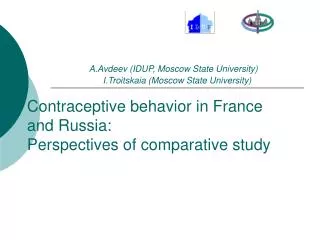
A.Avdeev (IDUP, Moscow State University) I.Troitskaia (Moscow State University)Contraceptive behavior in France and Russia: Perspectivesof comparative study
Sub-sample disign: Selection criteria Respondents who answered a question about current contraceptive use were: • In reproductive ages • Physically able to have children(both R and R’s partner) • Non-pregnant (if R=female) or not having a pregnant partner (if R=male)
Sub-sample disign: Selection criteria Respondents who answered a question about current contraceptive use were: • In reproductive ages • Physically able to have children(both R and R’s partner) • Non-pregnant (if R=female) or not having a pregnant partner (if R=male)
Sub-sample disign: Selection criteria Respondents who answered a question about current contraceptive use were: • In reproductive ages • Physically able to have children(both R and R’s partner) • Non-pregnant (if R=female) or not having a pregnant partner (if R=male)
Contraceptive method mix u = 83.1% u = 83.6%
Logistic regression: pill users (I) • ═══════════════════════════════════ • VariableOdds ratios • FranceRussia • ─────────────────────────────────── • Education • Less than secondary 0.95 0.42*** • Secondary (ref.) 1 1 • More than secondary 0.78** 1.12 • In ed. attainment 2.01** 2.39*** • Employment • Employed (ref.) 1 1 • Unemployed 0.80* 0.65*** • N of observations 2 065 2 299 • ──────────────────────────────────── • controlled for Age, Type of partnership, Parity, Fertility intentions
Logistic regression: pill users (III) • ═══════════════════════════════════ • VariableOdds ratios • FranceRussia • ─────────────────────────────────── • Education • Less than secondary 0.47 (0.95) 0.12** (0.42) • Secondary (ref.) 1 1 • More than secondary 2.36 (0.78) 1.82* (1.12) • In ed. attainment 2.29* (2.01) 2.25** (2.39) • ──────────────────────────────────── • - controlled for Age, Type of partnership, Parity, Fertility intentions • - Interaction Age*Education